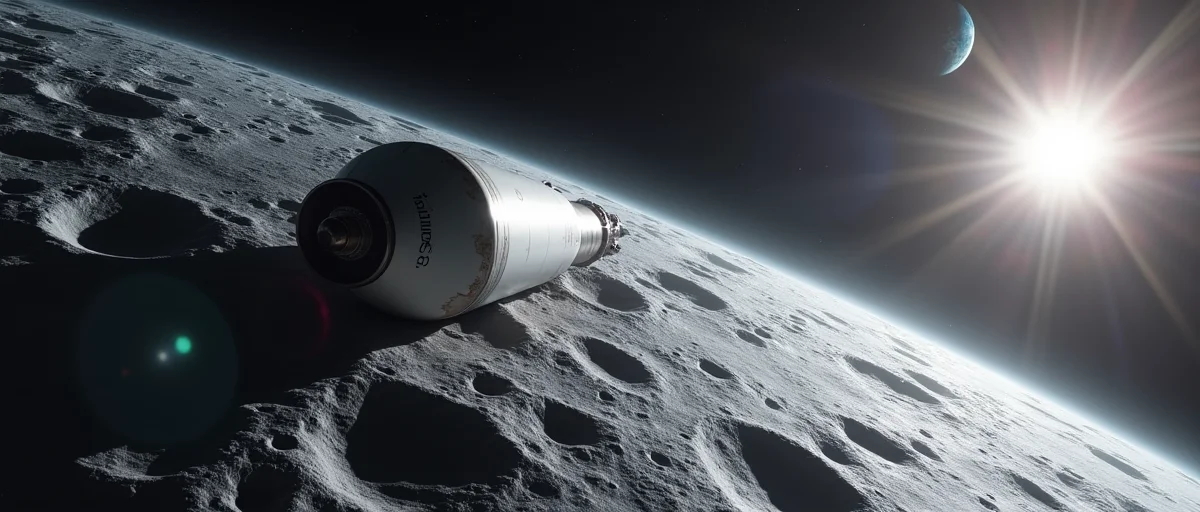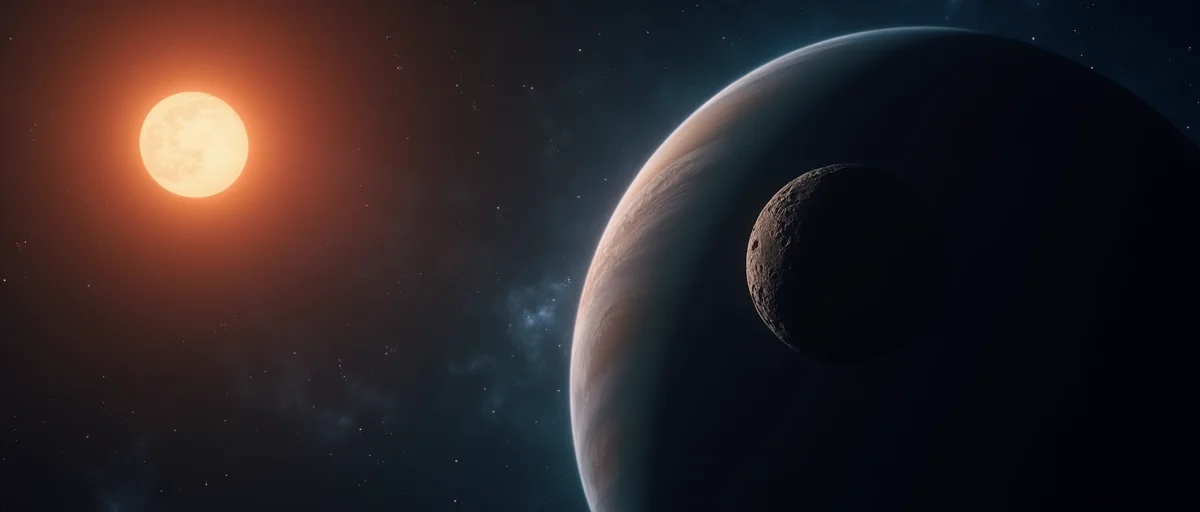
Astronomers may have found the first exomoon ever detected, orbiting a planet 73 light-years from Earth. This historic candidate challenges our definitions of stars, planets, and moons, opening a new frontier in exoplanetary science.
For decades, astronomers have confirmed thousands of exoplanets in distant solar systems. But until now, not a single moon beyond our solar system—an exomoon—has been conclusively identified. That may have just changed.
Scientists have detected a promising exomoon candidate around an exoplanet in a system approximately 73 light-years from Earth. If confirmed, this discovery would mark the first exomoon ever found, expanding our understanding of planetary systems and their potential for habitability.
This isn’t just another celestial pinprick in a telescope image. It’s a blurry line being erased between what we call a star, a planet, and a moon. And for technologists and space enthusiasts, it represents a data-rich puzzle that could reshape planetary science.
An exomoon is exactly what it sounds like: a natural satellite orbiting an exoplanet that lies outside our solar system. Just as our Moon influences tides, axial tilt, and even the stability of Earth’s climate, moons in other solar systems could play a critical role in creating habitable conditions on their host planets.
Yet exomoons have remained tantalizingly out of reach. The distances are enormous, the signals are faint, and the tools historically weren’t sensitive enough to spot them. Until two decades ago, even exoplanets were cutting-edge. Now we’ve cataloged more than 5,000 worlds, but zero confirmed moons.
This candidate changes the narrative. The discovery demonstrates that we have finally reached a point where we can detect objects far smaller than planets, orbiting already-hard-to-see worlds light-years away.
The technical challenge is monumental: an exomoon is like spotting a firefly next to a lighthouse from across the Pacific Ocean. Yet the payoff is a more complete, nuanced picture of how planetary systems form, evolve, and potentially host life.
The star system in question lies about 73 light-years from Earth, a relatively close neighbor on galactic scales. That proximity made it possible to gather detailed observations and identify a faint, repeating dip in starlight consistent with an exomoon passing in front of its host planet.
According to NASA’s Exoplanet Archive, the number of previously confirmed exomoons is exactly zero. This candidate, if verified, would set the historical benchmark. The research, analyzed by Wired in 2024, describes the detection as a first in the search for moons beyond our solar system.
“This discovery is blurring the lines between stars, planets, and moons.” — Wired Staff
That quote captures the scientific significance. Objects we once thought of as discrete categories now appear to be points on a complex spectrum. A large moon can look like a small planet; a small planet can be captured by a larger world. The discovery forces us to redefine not just what a moon is, but what a solar system can do.
Of course, extraordinary claims require extraordinary evidence. Follow-up observations are needed before the team can confidently say “confirmed.” But the initial signal is strong enough to be taken seriously by astronomers worldwide.
The candidate’s size and orbital configuration are not what you’d expect from an ordinary moon. Early indications suggest it may be relatively large, perhaps comparable to a small planet. This has immediately triggered debate about where the planetary classification ends and the lunar classification begins.
Our own Moon, for example, is unusually large relative to Earth. Some theories suggest it was formed from a giant impact. Other large moons in our solar system, like Jupiter’s Ganymede, are bigger than Mercury. If this exomoon is similarly outsized, it hints that such arrangements may be more common than we thought.
The discovery also poses a philosophical question: If a moon is large enough to hold an atmosphere, or even to host oceans beneath its surface, should we treat it with the same habitability considerations as a planet? For astrobiologists, that’s not just semantics—it changes which worlds we prioritize when searching for signs of life.
The established categories were built from a single, limited sample: our solar system. Now that we can observe other systems, those categories are beginning to crumble. Each new discovery adds another data point, forcing our models to become more flexible.
Finding an exomoon is a multi-step process that builds on exoplanet-detection methods. Here’s how it generally works in this case:
The trend in exomoon searches is clearly rising. Since the Kepler mission began in 2009, space telescopes have continuously improved both their precision and their observing strategy. Kepler’s legacy dataset still yields new discoveries, and newer instruments like TESS are pushing the envelope even further.
What makes this particular detection stand out is that the signal survived rigorous statistical testing. The team reportedly explored alternative explanations, such as another planet in the system or stellar activity, and none fit the data as cleanly as an exomoon candidate.
Exomoons may be fascinating distractions for planetary scientists, but they might also be prime targets in the search for life. In our own solar system, tidally heated moons like Enceladus and Europa are considered among the most promising places to find microbial life beyond Earth.
If exomoons are common, then the number of potentially habitable worlds in the galaxy may be much larger than the number of potentially habitable exoplanets. A rocky exomoon orbiting a gas giant could enjoy enough tidal heating to maintain a liquid ocean under an icy crust, just like Europa.
That’s why this discovery matters for technology enthusiasts too. Machine learning, cloud computing, and high-precision photometry are all essential to this work. The same data-science techniques that power recommendation engines and autonomous vehicles are being used to find faint signals in the noise of the cosmos.
The practical takeaway is clear: the tools we build to solve terrestrial problems—image processing, time-series analysis, anomaly detection—are directly enabling breakthrough astronomical discoveries.
This exomoon candidate will now face heightened scrutiny. Teams will likely try to re-observe the system with more powerful telescopes, such as the James Webb Space Telescope (JWST), to search for the subtle infrared signatures that could confirm the moon’s presence.
JWST’s capabilities are ideally suited for this task. Its high sensitivity and precise pointing allow it to gather the tiny signals that ground-based telescopes could never resolve. If JWST or another observatory can detect the moon’s own thermal emission, that would be smoking-gun evidence.
But even before full confirmation, this candidate has already achieved something historic: it has proven that exomoons are accessible to current technology. The era of exomoon discovery could begin immediately, with dozens of new candidates being identified from existing datasets.
The future may also bring dedicated space missions designed specifically to find exomoons. Concept studies have proposed spacecraft with ultra-high-precision photometry, or interferometric arrays that can resolve nearby systems in unprecedented detail. These would take the search to an entirely new level.
The detection of an exomoon candidate 73 light-years from Earth is a watershed moment in astronomy. It marks the first promising candidate in a search that has come up empty for years, and it challenges the very definitions we use to describe the cosmos.
The key points to remember:
For technologists, this discovery is a reminder that data analysis, software innovation, and observational engineering can move the needle in unexpected places. The universe is full of faint signals, waiting for the right algorithms to uncover them. This exomoon candidate is proof that persistence in the hunt for “impossible” objects eventually pays off.
The search for moons beyond our solar system is no longer theoretical. It has found its first true candidate. And with advanced observatories on the horizon, the next few years could reveal a whole menagerie of hidden moons—each one expanding our understanding of what it means to be a planetary system.
An exomoon is a natural satellite that orbits an exoplanet, which is a planet located outside our solar system. Just like our Moon orbits Earth, an exomoon orbits a planet around another star. They are extremely difficult to detect because they are small and faint compared to their host planet and star.
Astronomers typically detect exomoons using the transit method, where they watch for tiny, repeated dips in a star's light as a planet passes in front of it. An exomoon causes an additional, smaller dip or slight variation in that signal. Detecting this subtle pattern requires extremely sensitive instruments and repeated observations, like the data gathered from this candidate.
No. According to NASA's Exoplanet Archive, the number of confirmed exomoons is exactly zero. This new detection is only a candidate, meaning it shows strong evidence but still needs verification through further observations before it can be officially confirmed as the first exomoon ever found.
Moons can play a crucial role in a planet's habitability by stabilizing its axial tilt, influencing tides, and affecting its climate, just as Earth's Moon does. If exomoons are common, they could also themselves be habitable environments. This discovery helps scientists understand how moons affect planetary systems and expands the types of places where life could potentially exist.
A planet orbits a star, while a moon orbits a planet. This exomoon candidate orbits an exoplanet, not the star directly. The blurry line between these categories is part of what makes the discovery exciting, as it challenges our definitions of stars, planets, and moons, especially when considering objects that may be large enough to be stars themselves or small enough to be moons.