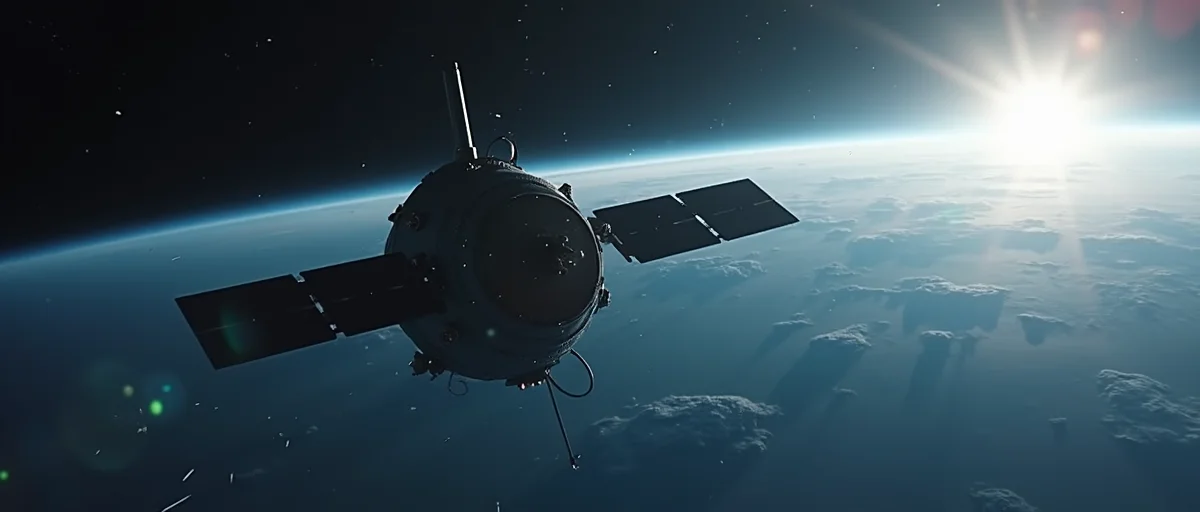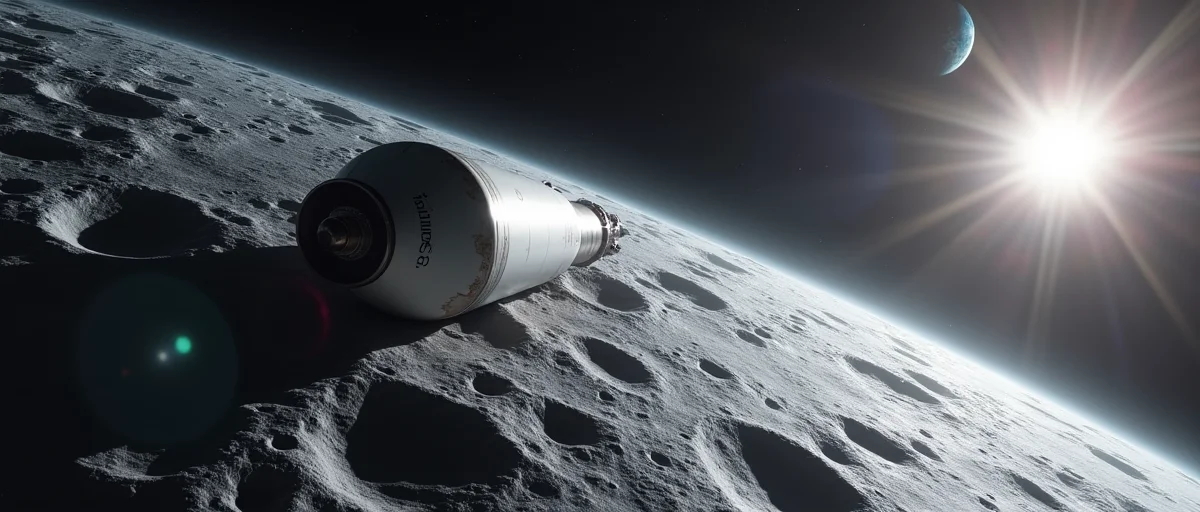
A SpaceX Falcon 9 upper stage will hit the Moon on March 4, 2022. Here’s why this historic crash matters and what it means for deep-space debris.
A forgotten piece of space hardware is about to make history. On March 4, 2022, a SpaceX Falcon 9 upper stage from the 2015 DSCOVR mission will crash into the far side of the Moon. It will be the first known accidental, forward-predicted impact of a human-made object on the lunar surface. While the impact zone is on the side facing away from Earth, the event is a powerful reminder that human debris now reaches far beyond Earth’s orbit.
The rocket body began its journey in February 2015, when it carried NOAA’s DSCOVR satellite to the Sun-Earth L1 Lagrange point, about 1.5 million kilometers from Earth. After deploying DSCOVR, the upper stage had no built-in method to de-orbit itself. Instead of falling into Earth’s atmosphere or drifting into a stable solar orbit, it entered a chaotic, eccentric orbit around our planet.
For the next seven years, the 4-metric-ton upper stage wandered under the gravitational pull of the Sun, the Moon, and Earth. Its unpredictable path made tracking difficult. In early 2022, independent astronomer Bill Gray identified the object and calculated that it would collide with the lunar far side at about 5,800 mph (2.58 km/s).
The stage was never equipped with the kind of disposal system that is now common on many commercial satellites. That left it at the mercy of gravitational forces, and those forces ultimately set it on a collision course with the Moon.
The story behind the prediction is almost as interesting as the crash itself. Bill Gray, who runs Project Pluto, initially identified the object while searching for near-Earth asteroids. Follow-up observations revealed that its trajectory and brightness matched a Falcon 9 second stage, not a natural space rock.
“This is a good reminder that a lot of stuff in deep space is in nonstandard orbits, and we don’t always know exactly where it is,” Gray told Wired.
The detection highlights an emerging challenge. As launch activity grows, more rocket bodies are being discarded in high orbits where they can remain for years—or decades. Tracking them demands continuous observations and rapid classification when new objects appear. The object was only identified as a rocket stage because astronomers compared its brightness and motion to known deep-space objects.
The Falcon 9 upper stage will strike the far side of the Moon, so observers on Earth will not see the moment of impact. But the collision itself may create a plume of ejecta that could be briefly visible through telescopes, similar to a meteor impact flash but much fainter and more distant.
According to NASA estimates, the impact should create a crater 10–20 meters in diameter. The exact size will depend on the angle of the collision, the density of the rocket body, and the composition of the lunar regolith. The Lunar Reconnaissance Orbiter, which orbits the Moon, may later pass over the site and capture before-and-after images, giving scientists a rare look at a fresh impact crater formed by human-made debris.
For experienced observers, the far side location makes the event challenging. The plume has to rise above the visible limb or be detected in reflected light from particles ejected beyond the lunar horizon. High-end observatories with sensitive cameras and precise pointing may catch it. Small backyard telescopes almost certainly will not.
What is certain is that the Moon’s surface will gain a new crater. It will remain there for millions of years, a permanent marker of humanity’s expanding footprint in cislunar space.
Most discussions about orbital debris focus on low Earth orbit, where defunct satellites and fragmented rocket stages threaten active missions. But the case of this Falcon 9 upper stage shows that debris is not confined to Earth’s immediate neighborhood.
The rocket body spent seven years in a trajectory that swung unpredictably between Earth and the Moon. That made it extremely difficult to track precisely, and nearly impossible to dispose of safely. The reason is simple: very few upper stages are equipped with propulsion systems that can guarantee a controlled burn after their primary mission ends.
Key takeaways for space operators:
This incident has renewed calls for clearer disposal rules for rocket stages in deep space. Since 2015, independent trackers have paid increasing attention to derelict objects in high orbits. By 2022, aerospace organizations were advocating for international guidelines that would require launch providers to plan for the entire lifecycle of every upper stage.
Jonathan McDowell, an astrophysicist at the Harvard-Smithsonian Center for Astrophysics, framed the event in practical terms. “It’s a great opportunity to learn more about what happens when a rocket body hits the Moon, but it’s not something that poses any threat to life on Earth,” he said.
For engineers and mission planners, this Falcon 9 incident is more than a curiosity—it is a systems-design problem.
Rocket stages deployed beyond low Earth orbit often lack de-orbit devices because their trajectories are assumed to be harmless. A stage left in deep space may eventually hit the Moon, an asteroid, or drift into a solar orbit. But “eventually” can span decades, and such objects are difficult to monitor after their radio transmitters go silent.
Mission operators can take several lessons from this event:
The DSCOVR Falcon 9 stage is not the only object in this category. Dozens of retired spacecraft and rocket bodies occupy high orbits, and many are not tracked as accurately as satellites in low Earth orbit. The need for better space situational awareness is now clearer than ever.
Despite its accidental nature, the March 4 impact offers a unique scientific opportunity. Rocket impacts on the Moon are usually scheduled and controlled, such as the LCROSS mission in 2009, which deliberately sent a Centaur rocket stage into a shadowed lunar crater. This event is different: a 4-ton object arriving at 2.58 km/s with an uncertain impact angle.
By observing the aftermath—whether through the debris plume, seismic signals, or later crater imaging—scientists can improve computer models of impacts on airless bodies. Those models are useful not only for lunar research, but also for planning future missions that may deliberately use impactors to expose buried materials and to understand impact risks for habitats and infrastructure on the Moon.
On March 4, 2022, a SpaceX Falcon 9 upper stage will crash into the far side of the Moon, marking the first predicted accidental lunar impact by a human-made object. The crash itself will not be visible from Earth, but its debris plume may be detectable, and its crater will be studied for years. More importantly, the event compels space agencies and commercial launchers to rethink how they dispose of hardware left in deep space.
For technology professionals, the lesson is clear: in an era of expanding lunar traffic and commercial spaceflight, good engineering must extend to the end of every object’s life. That means better tracking, clearer disposal standards, and a commitment to keeping even the most distant parts of the space environment predictable and safe.
The Falcon 9 upper stage is the second stage of a SpaceX Falcon 9 rocket that launched NOAA's DSCOVR satellite in February 2015. After deploying the satellite to a point about 1.5 million kilometers from Earth, the spent stage was left in a chaotic orbit rather than being disposed of. It weighs about 4 metric tons and is now on a collision course with the Moon's far side.
Independent astronomer Bill Gray, who runs Project Pluto, first spotted the object while searching for near-Earth asteroids. Follow-up observations compared its brightness and motion to known deep-space objects, revealing it was a Falcon 9 second stage. By tracking its trajectory and accounting for gravitational pulls from the Sun, Moon, and Earth, he calculated it would strike the lunar far side on March 4, 2022.
Planned lunar impacts are deliberate missions where spacecraft are intentionally directed into the Moon, often for scientific purposes, such as studying lunar soil or creating artificial craters. The Falcon 9 impact is accidental and forward-predicted; no one intended for the stage to hit the Moon, and it is not equipped with scientific instruments. This makes it the first known accidental, predicted impact of a human-made object on the lunar surface.
No, the crash poses no threat to Earth because the impact will occur on the far side of the Moon, which faces away from our planet. The Moon has no atmosphere, so the rocket stage will simply strike the surface and create a new impact crater. Scientists may be able to observe the crater and ejecta plume from orbit, providing useful data, but there is no risk of significant damage to the Moon.
This crash highlights the growing problem of human-made debris in deep space, not just in Earth's orbit. Many rocket bodies from older missions lack disposal systems and can wander unpredictably for years. The event underscores the need for better tracking, broader classification of deep-space objects, and international guidelines to ensure future upper stages are properly disposed of or placed in stable, non-risky orbits.