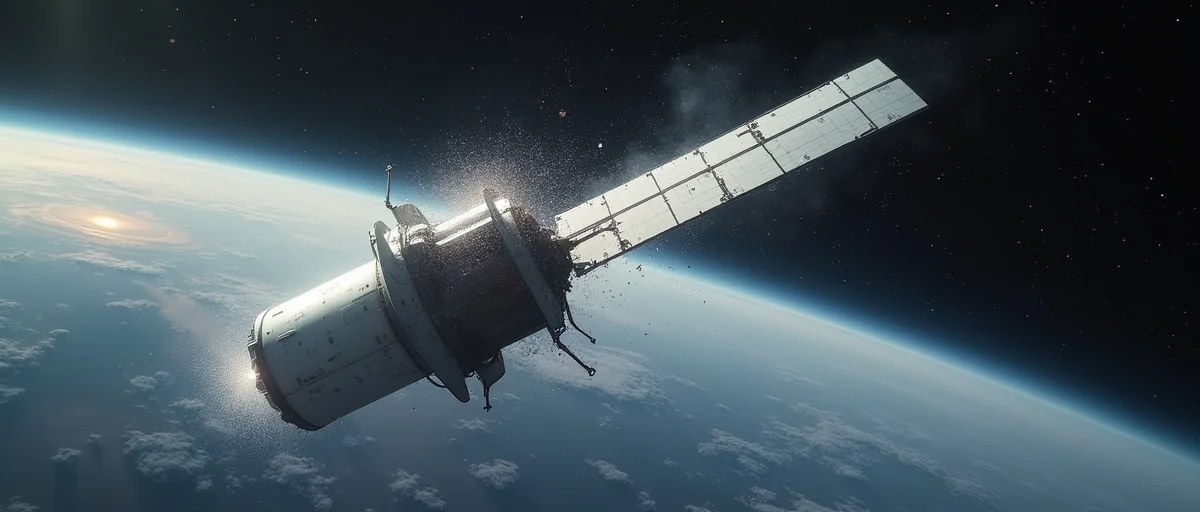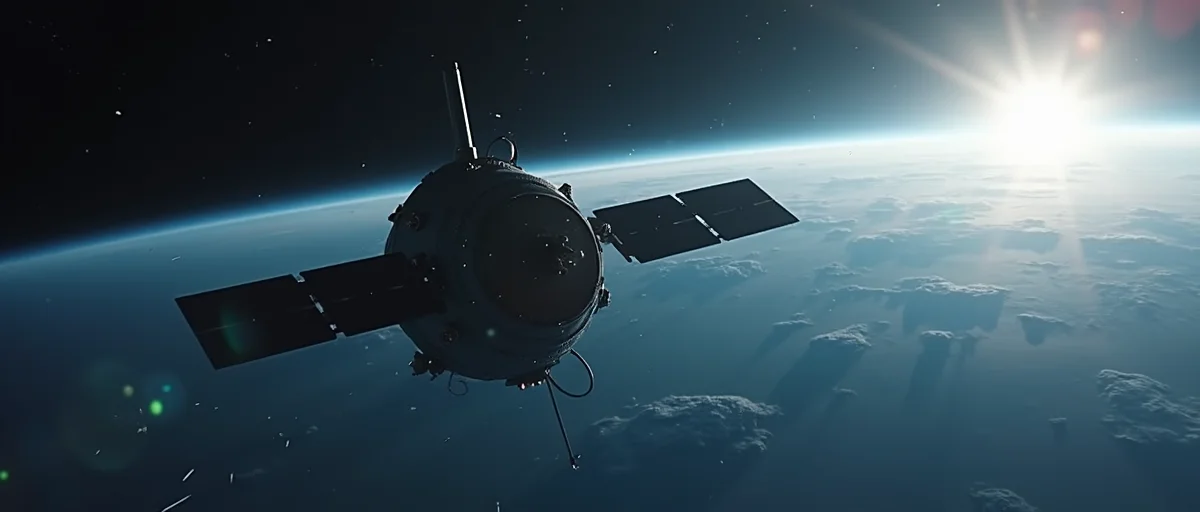
A commercial rescue mission for NASA's Swift telescope is in trouble after reaction wheel failures set the spacecraft spinning. Two of three wheels are down.
When a commercial spacecraft sets out to rescue an aging NASA observatory from an uncontrolled reentry, the margin for error is razor-thin. That margin got even thinner this month, when Katalyst Space Technologies’ Link satellite suffered reaction wheel failures less than 30 days after launch.
NASA reported that two of Link’s three reaction wheels are not operable. The cold gas thruster system also has partial loss of functionality. The failures set the spacecraft spinning, which has caused sporadic communications with ground controllers. It is a dramatic setback for a first-of-its-kind commercial mission designed to assist NASA’s Swift gamma-ray telescope.
Here is what we know, why reaction wheels are so important, and what this means for the future of satellite servicing.
Swift has spent more than two decades studying gamma-ray bursts and other high-energy cosmic events. But every satellite in low Earth orbit faces the same slow pull of atmospheric drag. Without a boost, Swift would eventually fall back to Earth. The risk is not just the loss of a valuable science mission; it is the uncertainty of where debris might land.
Link was designed to eliminate that risk. Built by Katalyst Space Technologies, Link is the centerpiece of a first-of-its-kind commercial effort to give Swift a controlled end of life. In theory, Link would rendezvous with Swift, match its orbit, and help lower it for a controlled reentry. The mission’s success would prove that private spacecraft can service and retire government science satellites safely.
That plan now hangs in the balance.
NASA’s preliminary assessment paints a difficult picture. In a statement reported by Ars Technica, the agency said:
“Preliminary investigation shows that two of Link’s three reaction wheels currently are not operable, and there is some loss of functionality in its cold gas thruster system.”
NASA announced the finding on Tuesday, with the investigation still underway. The phrase “currently are not operable” leaves some room for recovery, but two dead wheels on a spacecraft with only three is a serious handicap.
The second NASA statement explains the near-term impact:
“The Link satellite experienced issues with attitude control over the weekend, causing the spacecraft to spin and resulting in sporadic communications.”
That spin may not look dangerous from the outside. But for mission control, it is like trying to talk to a flashlight that is being swung on a rope. Every time the antenna faces Earth, there is a brief chance to send or receive data. The rest of the time, the signal is lost.
Those numbers are important because three-axis attitude control usually demands three independent actuators. It is possible to operate with fewer, but every missing wheel makes maneuvers slower, riskier, and less precise. For a mission that needs to chase down Swift, precision is everything.
Reaction wheels are the silent workhorses of spacecraft pointing. They are flywheels mounted along different axes. When the motor spins one wheel faster, the spacecraft rotates in the opposite direction. By controlling all three wheels, a satellite can point its instruments, antennas, and solar panels without using propellant.
The catch is that reaction wheels are mechanical. They contain bearings and moving parts that wear out in the vacuum of space. Over the past decade, reaction wheel failures in small satellites have remained a steady and well-known risk. That is not because of one specific flaw; it is because moving machinery always carries a probability of failure.
Engineers design around that risk with redundancy, software safeguards, and alternate actuators such as thrusters. Link has cold gas thrusters precisely for this job. But when both reaction wheels and thrusters are degraded, the safety margins shrink dramatically.
The first task for the Link mission team is to regain control of the spacecraft’s attitude. That usually starts with a “safehold” mode, where the satellite uses whatever sensors and actuators it trusts to stop spinning. Once the rotation rate is low enough, the remaining reaction wheel and the cold gas thrusters can work together to restore a stable attitude.
If the team can stabilize Link, the next challenge is restoring reliable communications. Without reliable data, engineers cannot assess the health of the rest of the spacecraft or plan the maneuvers needed for a rendezvous. The investigation will likely continue for weeks, not days.
It is too early to declare the mission lost. Space history contains many recoveries from degraded hardware. The Kepler space telescope, for instance, lost two of its four reaction wheels and still completed an extended mission by using sunlight pressure to help control its orientation.
But Kepler did not need to rendezvous with another spacecraft. Link does. That makes the margin for attitude control errors much smaller.
The Link mission sits at the intersection of two big trends. Commercial satellite servicing is rising in the 2020s, with companies building spacecraft that can inspect, refuel, extend the life of, or deorbit other satellites. At the same time, reaction wheel failures remain a persistent issue in small satellite design.
The failure of a commercial rescue vehicle has ripple effects far beyond one mission. It raises questions about the reliability of the entire servicing industry. If a satellite cannot keep itself stable, how can it be trusted to perform delicate operations near a NASA science mission?
That is why this incident matters so much. Commercial partnerships in space are not just about cost or schedule; they are about trust. Link was supposed to prove that a private satellite can help NASA manage its aging assets. Now it must prove something even more basic: that it can survive the hostile environment it was built for.
The Link satellite was built to rescue NASA’s Swift gamma-ray telescope from an uncontrolled reentry. Instead, it is now fighting to save itself. Two of three reaction wheels are down, and the cold gas thruster system is degraded, but the spacecraft is still alive. NASA and Katalyst have not given up, and recovery is still possible.
For space professionals, this is a powerful reminder that reliability in orbit is never guaranteed. Every component, especially every moving part, must be treated as a potential point of failure. The next few weeks will determine whether Link becomes a pioneering rescue vehicle or a sobering lesson in the fragility of space operations.
A reaction wheel is a spinning flywheel used by satellites to change their orientation without firing thrusters. By speeding up or slowing down the wheel, the spacecraft can rotate around its center of mass. When multiple reaction wheels fail, a satellite can lose the ability to point its instruments or antennas, which can disrupt communications and science operations.
The Link mission, built by Katalyst Space Technologies, was a commercial project designed to rendezvous with NASA's Swift gamma-ray telescope and lower it for a controlled reentry. Without this boost, Swift would eventually experience an uncontrolled fall to Earth due to atmospheric drag. The mission was meant to demonstrate that private spacecraft can safely retire government science satellites.
When reaction wheels fail, the satellite loses a primary means of controlling its orientation. It may begin to spin or tumble, making it difficult to keep solar panels pointed at the Sun or antennas pointed at Earth. That can lead to power problems, intermittent communications, and an inability to perform planned maneuvers.
NASA's preliminary investigation shows that two of Link's three reaction wheels are not operable and there is partial loss of its cold gas thruster system. No final recovery estimate has been announced, and engineers are still investigating. Even if some control can be restored, having only one working reaction wheel severely limits the spacecraft's ability to perform precise rendezvous and reentry maneuvers.
Controlled reentry ensures a spacecraft is directed to a safe, remote area of the ocean rather than falling unpredictably. This reduces the risk of debris striking populated areas and helps preserve the safety of people and property on the ground. For a valuable science mission like Swift, it also provides a planned, responsible end of life rather than a chaotic one.