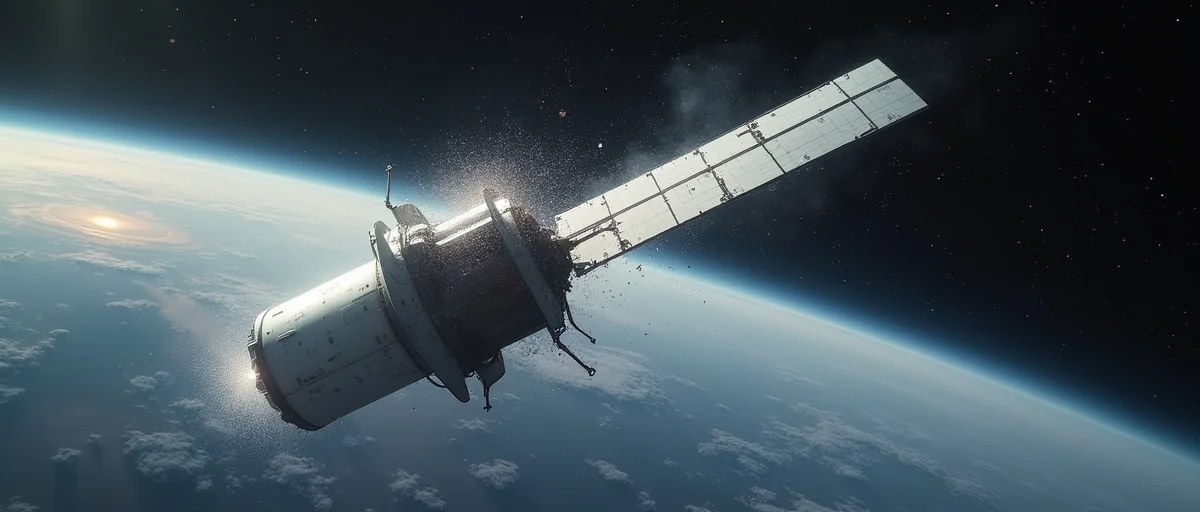
A pioneering commercial rescue mission for NASA's Swift gamma-ray telescope has hit a critical snag just weeks after launch. The Link satellite, built by Katalyst Space Technologies, suffered severe attitude control failures, losing two of its three reaction wheels and part of its thruster system. The mission to extend the life of a vital space observatory is now fighting to stabilize itself against rising odds.
What happens when the rescuer itself needs rescuing? This is the dizzying dilemma facing NASA and Katalyst Space Technologies just weeks after the launch of the Link satellite. Designed to be humanity’s first commercial spacecraft for orbital servicing and rescue, Link was meant to demonstrate a new era of space sustainability by extending the life of NASA’s Swift gamma-ray observatory. Instead, it has become a stark case study in the brutal complexity and high-risk nature of in-orbit operations.
The Swift Gamma-Ray Burst Mission is a crucial asset for astrophysics, detecting the most powerful explosions in the universe. The observatory is gradually losing altitude, and without a booster mission, it faces a fiery re-entry into Earth’s atmosphere within the next few years.
Enter the Link satellite, built by startup Katalyst Space Technologies. This spacecraft represented a beacon of the burgeoning commercial space servicing industry. The plan was for Link to autonomously rendezvous with Swift, carefully dock with the aging observatory, and perform a critical orbit-raising maneuver. This would effectively save a billion-dollar science mission for a fraction of the cost of building a new one.
Within its first month in orbit, the dream turned into an engineering nightmare. NASA officially announced the anomaly on Tuesday, highlighting the fragile nature of using cutting-edge commercial spacecraft for critical government servicing missions. The most alarming aspect of this failure is its timing. Launched less than a month ago, the Link satellite is still in its commissioning phase. Components that fail this early are rarely recoverable, hinting at a latent manufacturing defect or a severe design oversight rather than the gradual wear and tear expected later in a spacecraft’s life.
“Preliminary investigation shows that two of Link’s three reaction wheels currently are not operable, and there is some loss of functionality in its cold gas thruster system,” NASA stated.
This represents a catastrophic hardware failure for the spacecraft’s attitude control system. Reaction wheels are the precision gyroscopes a spacecraft relies on to maintain its orientation—or attitude—in the vacuum of space. Without them, a spacecraft cannot reliably point its solar panels at the Sun, its antennas at Earth, or its sensors at its target.
This combination is particularly devastating. Most spacecraft design philosophy relies on at least one backup for failure. The loss of two wheels simultaneously or in rapid succession, combined with a crippled backup system, severely limits the options available for recovery.
The loss of critical orientation control leaves the Link satellite in a state of spin. While spinning spacecraft are not immediately lost—gyroscopic stability can sometimes be an asset—it creates cascading challenges for the ground team.
A spacecraft’s reaction wheels are primarily used to counteract external torques from solar pressure and gravity gradients that cause it to tumble. Without them, and with only partial thruster control, the spacecraft’s exact rotational state is difficult to predict and control.
Despite this dramatic setback, the broader trend of commercial satellite servicing is unmistakably rising. The space industry is actively building the infrastructure for on-orbit services, including refueling, repair, and decommissioning. Missions like Northrop Grumman’s Mission Extension Vehicles (MEVs) have successfully docked with aging telecom satellites, proving the commercial viability of life extension.
Katalyst’s Link mission was meant to push this frontier further by targeting an active scientific asset rather than a passive commercial one. The rescue of Swift was intended to be the showcase demonstration that commercial servicing could be trusted with high-priority, billion-dollar scientific payloads.
The research data indicates that reaction wheel failures are a historically stable risk trend. They are one of the most common failure modes for spacecraft in orbit. Moving parts in a vacuum with sensitive bearings are inherently vulnerable.
From the famous Kepler mission losing its wheels and requiring a repurposing to the standard wear and tear seen on International Space Station control moment gyroscopes, reaction wheel failure is a known enemy of spacecraft longevity. The issue with the Link satellite is less about the failure mode itself and more about the speed and severity of its occurrence on a brand-new commercial spacecraft.
NASA and Katalyst are currently deep in the anomaly investigation. Is it a software bug, a hardware fault, or a mechanical jam? The recovery path depends entirely on the root cause.
The road to recovery is exceptionally narrow. Recovering a satellite with a reduced wheel set involves a complex software reconfiguration of the attitude determination and control system (ADACS). Engineers must upload new algorithms that can utilize the remaining hardware resources. A miscalculation could send the satellite into a faster spin, breaking the fragile communication link entirely. The stakes could not be higher.
This incident provides several hard lessons for the rapidly commercializing space industry.
The Link satellite’s predicament is a sobering vignette for the burgeoning space economy. The very technologies meant to make spaceflight cheaper and more accessible—commercial spacecraft, standardized buses, and rapid manufacturing—can introduce new and unexpected failure modes. While the dream of a robust orbital servicing infrastructure remains very much alive, the spinning Link satellite serves as a critical reality check. For now, engineers race against the clock, not just to save a revolutionary spacecraft, but to salvage the future of a billion-dollar space telescope and the very promise of commercial space rescue. The eyes of the space industry are fixed firmly on this tumbling satellite, waiting to see if it represents a temporary setback or a permanent end to a historic mission.
The Swift Gamma-Ray Burst Mission is a NASA space observatory that detects and studies gamma-ray bursts, the most powerful explosions in the universe. It is gradually losing altitude and faces a fiery re-entry if not boosted to a higher orbit. This mission makes Swift a vital asset for astrophysics.
Reaction wheels are rotating devices used to control a spacecraft's orientation (attitude) without expelling propellant. They allow precise pointing of instruments and antennas. The failure of two of three reaction wheels on the Link satellite severely compromises its ability to perform its planned docking and orbit-raising maneuvers.
Shortly after launch, the Link satellite experienced a critical anomaly during its commissioning phase. Two of its three reaction wheels became inoperable, and there was also some loss of functionality in its thruster system. This early failure suggests a potential manufacturing defect or design oversight rather than normal wear and tear.
The rescue mission is now in serious jeopardy, as the Link satellite struggles to stabilize itself after the attitude control failures. Engineers from NASA and Katalyst Space Technologies are investigating the anomalies, but the early failure of key components makes a successful recovery uncertain. The mission's future depends on whether the satellite can regain enough control to proceed.
Commercial satellite servicing aims to extend the life of valuable space assets through tasks like refueling, repairing, or orbit adjustment. It can save costs compared to building replacement satellites and helps reduce space debris. The Link mission was intended to demonstrate this capability, but its current struggles highlight the technical challenges and risks involved in such operations.