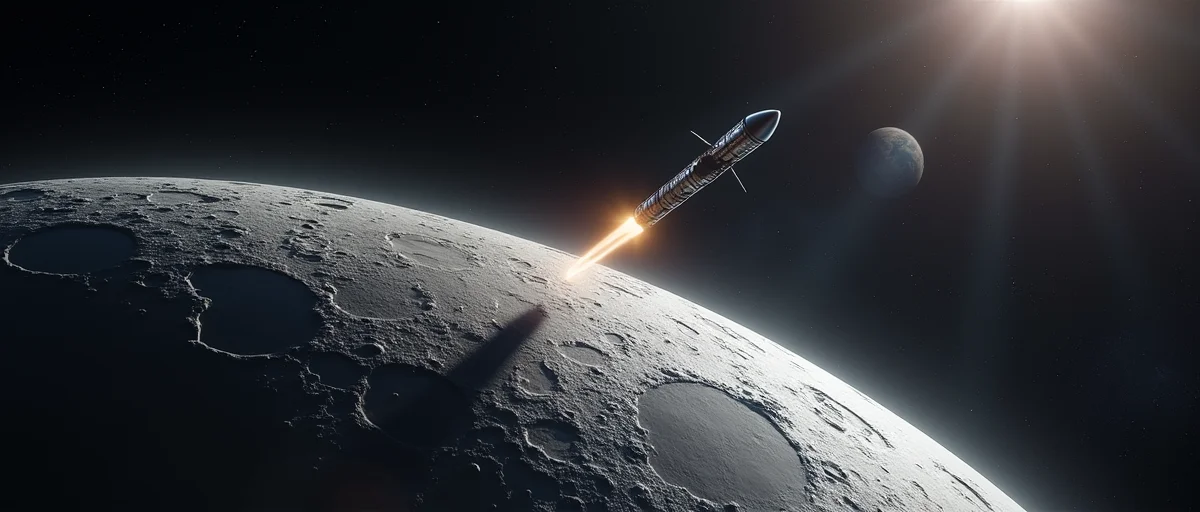
An uncontrolled SpaceX Falcon 9 upper stage will hit the Moon on Wednesday, highlighting orbital debris risks and the urgent need for better rocket disposal.
The Moon is about to gain a new crater. A SpaceX Falcon 9 second stage is on an uncontrolled trajectory and will collide with the Moon early Wednesday morning. It will not be a gentle landing. Because the Moon has no atmosphere, there is no air to slow the stage down or break it apart. It will strike the surface directly, leaving behind a fresh impact scar.
This is not a planned mission. The rocket stage is not being steered toward the Moon for scientific purposes. Instead, it is the unintended end of a hardware component that previously helped launch two private lunar landers into space. For technology professionals, the event is a rare, visible demonstration of what happens when spent rocket stages are left in unstable orbits: they eventually come down somewhere.
Before it became an uncontrolled object, the Falcon 9 upper stage performed a legitimate commercial function. According to a New York Times article summary, it launched two private lunar landers before its second stage was left in orbit. That makes the stage part of a broader shift toward commercial lunar exploration.
The key facts from the research are straightforward:
These numbers tell an important story. Commercial Moon missions are no longer rare. More companies are targeting the lunar surface, and each mission requires powerful rocket stages to get there. But the end-of-life management of those stages has not kept pace.
The Falcon 9 upper stage is not coming back to Earth. It is on a path that will intersect the Moon’s orbit, and because the Moon has no atmosphere, the stage will make a direct impact.
This is different from an Earth reentry. Objects falling to Earth often burn up in the atmosphere, and those that survive can be tracked and recovered. The Moon has no such protection. The Falcon 9 stage will hit the surface intact, at extreme speed, instead of experiencing atmospheric ablation.
What is most notable is the lack of control. In Earth orbit, operators can command a satellite to perform a deorbit burn. In cislunar space, the decision space is different. The stage was left in a long, evolving trajectory, and no engine burn will be made to alter its path.
This is a classic case of orbital mechanics determining the final outcome rather than human decision-making. The stage’s orbit slowly evolved until a lunar impact became predictable. Then, once the trajectory was set, the impact became unavoidable.
Most people associate space debris with low Earth orbit. The majority of cataloged objects, from dead satellites to fragments of old rockets, orbit within a few thousand kilometers of our planet. But this event proves that debris issues are not confined to Earth orbit.
When a rocket stage is used for a lunar mission, it often remains in a highly elliptical orbit that extends well beyond geostationary altitude. If it is not intentionally disposed of, that stage can linger for years. Eventually, its orbit can be perturbed by the gravity of Earth, the Moon, and the Sun, sending it on a collision course with one of those bodies.
The broader trends are concerning:
Yet the infrastructure to prevent incidents like this one is incomplete. We track thousands of objects in low Earth orbit, but fewer sensors are focused on cislunar space. A rocket stage on a lunar-transfer trajectory can go unnoticed until it is too late.
The event is not a failure of SpaceX’s core mission. The Falcon 9 successfully completed its primary objective by delivering the lunar landers. But it is a reminder that launch providers and mission planners must think about the full lifecycle of every stage.
One widely discussed practice is the use of reusable first stages, which SpaceX pioneered. The Falcon 9’s first stage returns to Earth and lands, reducing waste at the bottom of the rocket. The second stage, however, is expendable. It is not designed to return. On Earth-orbit missions, second stages often perform a controlled deorbit burn. On lunar missions, that is more difficult because the stage may not have enough propellant after delivering heavy payloads to a high-energy orbit.
This trade-off is at the heart of the problem. Engineers must balance payload capacity, cost, and safety. But leaving an upper stage in an unstable lunar-transfer orbit should no longer be the default choice.
What could have been done differently? Several disposal options exist for upper stages on lunar missions:
Each option comes with a cost. A heliocentric orbit requires extra velocity. A controlled lunar impact requires precise navigation. But doing nothing is no longer acceptable, especially as traffic to the Moon increases.
Although no one will be on the lunar surface to watch, the impact could still be observable. Ground-based telescopes might catch a brief flash as the stage hits the regolith and throws up a plume. The exact observability depends on where and when the strike occurs, as well as instrument sensitivity.
For researchers, even an uncontrolled impact is an opportunity. It can reveal how large objects interact with the Moon’s surface, how much ejecta is produced, and how lunar terrain responds to high-speed impacts. But the scientific benefit does not excuse the lack of disposal planning. This is an accidental experiment, not a designed one.
The regulatory framework for orbital debris was designed for Earth orbit. International guidelines, such as those developed by the Inter-Agency Space Debris Coordination Committee, focus on limiting debris in low Earth orbit and geostationary orbit. There is far less guidance for cislunar missions.
This creates a gray zone. Launch providers and operators may not have a clear obligation to dispose of lunar-transfer stages in a sustainable way. Even when best practices exist, they are often voluntary.
Policymakers and regulators should consider several actions:
These changes would not stop this week’s crash. But they could prevent similar incidents in the future.
No one is in direct danger from this impact. But the equation will change as more missions carry astronauts or build permanent infrastructure. A large metal cylinder hitting the Moon at extreme speed would be devastating to anything in its path.
Future lunar bases will need safety buffers, trusted disposal practices, and real-time awareness of incoming objects. The sooner the industry treats lunar-transfer debris as a serious hazard, the easier it will be to protect crews and equipment.
The SpaceX rocket crash into the Moon will be studied by orbital mechanics experts, regulatory lawyers, and mission planners. It is a textbook example of how a routine launch can create an unintended consequence years later.
For technologists, the lesson is straightforward: the decisions made during rocket design and mission planning have long-term environmental and safety implications. Even in the emptiness of space, there is no such thing as “out of sight, out of mind.”
Commercial lunar missions will only grow in the coming years. If the industry treats spent hardware as an afterthought, more accidental craters will follow. The Moon may not have an atmosphere to burn up rocket stages, but it does have a record of every object that reaches it—and this Falcon 9 upper stage is about to become part of that record.
The impact is a reminder that space exploration is still a human activity with human consequences. The next step is to make sure those consequences are intentional. With more private landers on the way and higher launch rates ahead, the time to define responsible rocket disposal is now.
An uncontrolled SpaceX Falcon 9 upper stage that previously helped launch two private lunar landers is on a trajectory that will collide with the Moon. Because the Moon has no atmosphere, the rocket stage will hit the surface directly at high speed, creating a new impact crater. This is an unintended end-of-life event, not a planned lunar mission.
There is zero direct risk to people, as the rocket stage will impact the Moon, not Earth. The Moon itself will only gain a crater; there is no atmosphere or ecosystem to harm. The broader danger is to space operations, since this event shows how leftover rocket stages in unstable orbits can create unpredictable debris hazards for future missions.
The Moon has virtually no atmosphere, so there is no air friction to slow the rocket down or break it apart. On Earth, objects entering the atmosphere often burn up due to extreme heating from atmospheric drag. On the Moon, the stage will hit the surface intact at extreme speed instead.
A controlled disposal uses the rocket's remaining fuel to steer it into a safe path, such as a remote ocean splashdown on Earth or a planned trajectory away from operational orbits. An uncontrolled reentry happens when a spent stage is left in an unstable orbit and its trajectory evolves naturally, sometimes leading to accidental impacts. This event is a reminder that proper disposal is essential to avoid adding to orbital debris.
It highlights a growing gap between the rising number of commercial Moon missions and the end-of-life management of rocket stages. As more companies launch lunar landers, more spent hardware will be left in orbit unless operators adopt better disposal practices. The event is likely to increase calls for international guidelines and better tracking of debris in the Earth-Moon system.