The James Webb Space Telescope is transforming astronomy, revealing galaxies that existed less than 300 million years after the Big Bang and challenging long-held models of galaxy formation. Discover how JWST's infrared vision is rewriting cosmic history.
In less than two years of operation, the James Webb Space Telescope (JWST) has fundamentally shaken our understanding of the early universe. Astronomers using JWST’s powerful infrared instruments have pushed their gaze closer to the Big Bang than ever before, uncovering galaxies that are far more massive and more mature than prevailing models predicted. These discoveries are not just adding new data points—they are forcing a paradigm shift in cosmology.
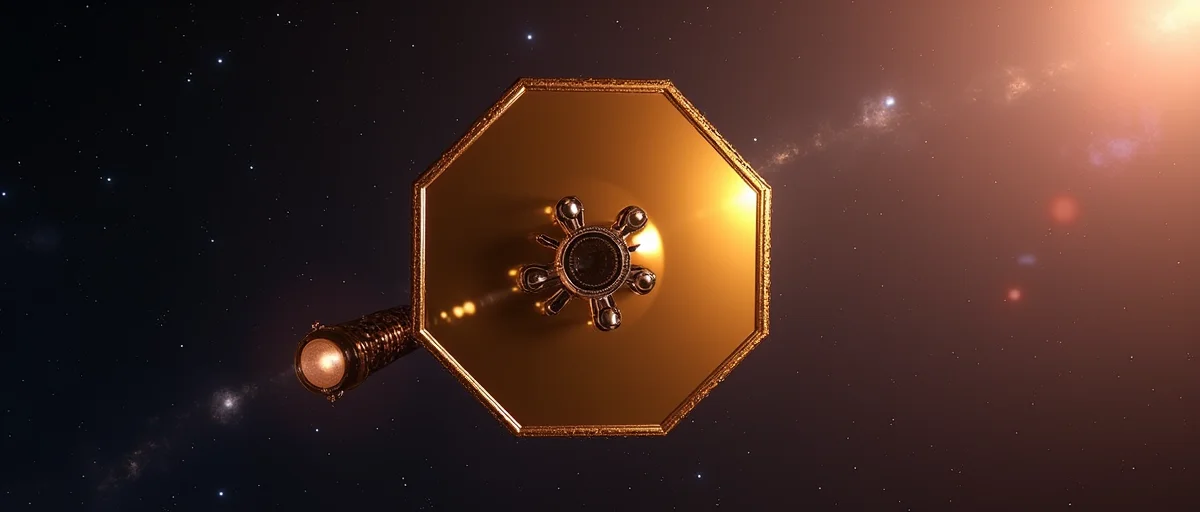
The James Webb Telescope is often described as a time machine, and for good reason. Because light takes time to travel across the cosmos, looking farther away means looking further back in time. JWST’s 6.5-meter primary mirror gives it roughly six times the light-collecting area of the Hubble Space Telescope, enabling observations of galaxies so distant and faint that they were completely invisible to previous observatories.
JWST’s real breakthrough, however, is its infrared capability. As light from the earliest galaxies travels across the expanding universe, its wavelength stretches—a phenomenon known as redshift. By the time this ancient light reaches us, it has shifted into the infrared spectrum. This makes JWST uniquely equipped to see the universe’s earliest objects that Hubble, optimized for optical light, could never fully resolve.
The telescope’s most dramatic achievement so far is the spectroscopic confirmation of JADES-GS-z14-0, a galaxy that existed a mere 290 million years after the Big Bang—less than 3% of the universe’s current 13.8-billion-year age. With a redshift of 14.32, this galaxy is the most distant confirmed object ever observed.
This single finding has profound implications. Luminous galaxies that formed over 13.5 billion years ago simply should not have existed in such abundance, according to many pre-JWST models. JWST’s observations show that the early universe was not a quiet, dark place as once thought, but a vibrant arena where stars and galaxies formed rapidly.
One of the most striking findings to emerge from JWST data is what astronomers call the ‘too early, too massive’ problem. A 2023 study published in Nature by Ivo Labbé and colleagues identified six galaxies at redshifts 7.4 to 9.1—meaning they appeared when the universe was just 500 to 700 million years old.
These galaxies appear as mature as the Milky Way, with masses of roughly 10 billion solar masses or more. The discovery directly challenges simple dark matter halo predictions.
“We expected to find little baby galaxies at this early time, but instead we’ve found galaxies that are as mature as our own galaxy,” said Ivo Labbé, lead author of the study.
Erica Nelson, co-author of the research, echoed this surprise: “These galaxies are very much more massive than anyone expected.”
According to standard cosmological models, galaxies grow hierarchically—small clumps merge into larger structures over billions of years. Finding fully-formed galaxies just a few hundred million years after the Big Bang is like discovering a fully grown adult in a kindergarten classroom. The timeline simply does not fit.
Deep-field images from JWST have revealed thousands of galaxies in patches of sky no larger than a grain of sand. This extraordinary density of resolved galaxies—many showing intricate spiral and irregular structures—has opened new possibilities for statistical astronomy.
Researchers are now using these deep fields to study:
These statistical approaches allow astronomers to move beyond small samples and begin constructing a rigorous census of the early universe.
JWST is also revealing a side of the early universe that was previously hidden—literally. Many ancient galaxies are shrouded in dust that absorbs visible and ultraviolet light, but JWST’s infrared instruments can pierce through this obscuring veil.
The result is a more complete picture of the early cosmos. In particular, JWST has revealed dust-obscured star formation and supermassive black holes in galaxies just a few hundred million years old. These observations are essential for understanding cosmic reionization—the epoch when radiation from the first stars and black holes stripped electrons from hydrogen atoms, transforming the universe from neutral to ionized.
By combining infrared imaging with spectroscopy, JWST is capturing the kinds of energetic processes that drove this critical cosmic phase transition.
The implications of JWST’s discoveries extend well beyond one telescope’s findings. Cosmologists are increasingly considering revisions to the standard cold dark matter model, which has served as the backbone of cosmic structure formation for decades.
Some are testing modified dark matter models that would allow for more efficient early galaxy formation. Others are examining whether an enhanced role for primordial magnetic fields, early supermassive black hole seeding, or other exotic mechanisms could explain how massive galaxies formed so quickly.
“The beautiful diversity and incredible detail of the Webb telescope’s images will have a profound impact on our understanding of the universe,” said Thomas Zurbuchen, former associate administrator for NASA’s Science Mission Directorate. That impact is now being felt in theoretical papers and at conferences worldwide.
JWST is far from finished rewriting cosmic history. The telescope is still early in its operational lifetime, and astronomers are planning an ambitious slate of deep-field observations and spectroscopic surveys to probe the universe’s first billion years.
A few key areas to watch:
These efforts will tell us whether the current surprises are genuine puzzles requiring new physics, or merely statistical outliers that will fade with more data. Either way, the centuries-old quest to understand our cosmic origins is entering an exciting new chapter.
The James Webb Space Telescope has transformed the ancient cosmos from a theoretical abstraction into a vivid, concrete reality. By revealing galaxies that existed less than 300 million years after the Big Bang—some as massive as the Milky Way at just 500-700 million years old—JWST has challenged assumptions that held for decades. The result is a more dynamic, more surprising universe than models predicted.
Actionable takeaways:
The James Webb Telescope has not just changed our understanding of the ancient cosmos; it has rewritten the story of where we come from. And the best chapters may still lie ahead.
The James Webb Space Telescope (JWST) is a large infrared space observatory launched in 2021. It is important because its sensitive infrared instruments allow astronomers to see the earliest galaxies in the universe, which are too distant and faint for earlier telescopes like Hubble to observe.
Redshift is the stretching of light toward longer wavelengths as the universe expands. Because light from very distant galaxies has traveled for billions of years, it shifts from visible light into the infrared, so JWST's infrared vision is essential for observing the oldest and most distant objects.
JWST has a larger primary mirror and observes primarily in infrared, while Hubble observes mainly in optical and ultraviolet light. This means JWST can detect much fainter, more distant objects whose light has been redshifted into the infrared, effectively giving it a clearer view of the early universe.
JADES-GS-z14-0 is a galaxy that existed about 290 million years after the Big Bang, with a redshift of 14.32. Its discovery is significant because it is one of the most distant confirmed galaxies ever found, showing that luminous galaxies formed far earlier than many models predicted.
It refers to JWST's discoveries of galaxies that appear surprisingly massive and mature when the universe was less than about 5 percent of its current age. These findings challenge current models of galaxy formation, which expected galaxies to grow slowly through mergers and take much longer to become luminous.