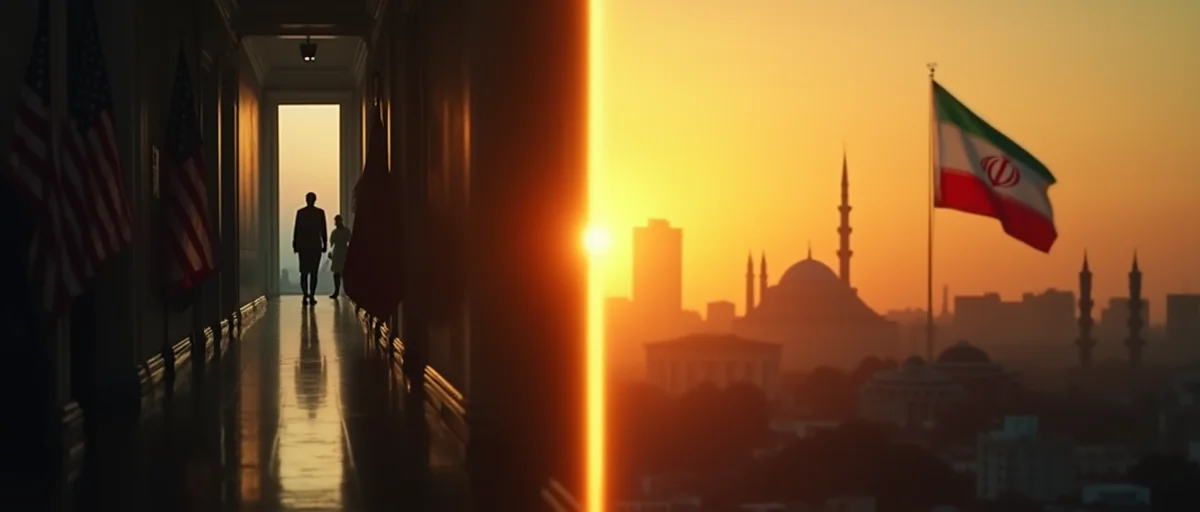
Iran denies formal talks with Washington even as it signals the U.S. is ready to return to nuclear commitments. With the Strait of Hormuz and 60% uranium enrichment in play, the fragile diplomatic window carries global stakes.
A day after President Trump said a deal with Iran is near, Tehran issued a blunt denial: no formal talks are underway. Yet in the same breath, Iranian officials acknowledged that Washington appears ready to return to its ‘commitments.’ The contradiction may be diplomatic posturing, but the stakes are anything but symbolic. With 20% of global petroleum liquids transiting the Strait of Hormuz and Iran’s uranium enrichment at 60% purity, every signal from Tehran and Washington ripples through energy markets, regional security, and technology infrastructure worldwide.
Iran’s denial directly contradicts President Trump’s claim that a deal is near. But the simultaneous suggestion that the U.S. is ready to return to ‘commitments’ signals a possible shift toward restoring nuclear-related obligations, even while formal negotiations were denied. That phrase is significant. It points back to the Joint Comprehensive Plan of Action (JCPOA), the 2015 nuclear accord from which the U.S. exited in 2018.
The involvement of Treasury Secretary Bessent in the context reveals a key driver: financial sanctions and economic pressure are the beating heart of this diplomatic dynamic. Washington’s leverage over Iran depends on a dense web of financial restrictions. Any negotiation would revolve around how much sanctions relief Iran receives in exchange for curbing its nuclear program.
The conflicting statements may be intentional. Both sides are likely posturing for domestic and international audiences. Hardliners in Tehran need to show steadfastness. The U.S. administration wants to demonstrate diplomatic momentum. The result is a fragile diplomatic window, where words matter far more than transcripts.
The Strait of Hormuz is one of the world’s most critical maritime chokepoints. According to the U.S. Energy Information Administration, about 20% of global petroleum liquids consumption passes through it (2023). That alone makes any U.S.-Iran diplomatic move a major factor for energy markets and regional security.
For technology professionals, the connection may not be obvious at first. But energy price spikes directly affect data center operating costs, high-performance computing, and blockchain networks. A Hormuz disruption could cause oil prices to jump, raising electricity costs for cloud infrastructure and impacting the economics of energy-intensive applications like AI model training. Hyperscale cloud operators design energy procurement strategies months in advance. A sustained oil price surge would increase electricity costs in many regions, especially those relying on natural gas and oil-fired power plants.
The 2026 trend data points to ‘rising oil supply risk’ in the Middle East. This is not a hypothetical. Shipping insurance premiums rise, freight schedules are delayed, and logistics algorithms that optimise global supply chains must account for new risk. Technology companies that build resilience into their energy and supply chains will weather the volatility better than those that assume cheap, stable energy will last forever.
Iran’s nuclear program has advanced steadily since the U.S. withdrawal from the JCPOA. The International Atomic Energy Agency reports Iran’s enriched uranium purity at 60%, close to weapons-grade (2024). That is a serious threshold. Weapons-grade uranium is typically enriched above 90%, but 60% significantly shortens the breakout time.
This makes the diplomatic stakes urgent. Every month that passes without a deal brings Iran closer to a position where it could race for a bomb if it chose to do so. Regional security is directly affected. Israel, Saudi Arabia, and Gulf states are closely watching. Any military escalation would have immediate global repercussions.
An IAEA verification gap is another concern. If inspectors cannot fully verify enrichment activities, trust deteriorates further. Technology’s role in monitoring—from satellite imagery to outbound data analytics—becomes more important as a check on nuclear activity. The trend of diplomatic volatility in U.S.-Iran relations is unstable, according to the research data. That instability is mirrored inside Iran’s nuclear program: the more pressure Iran faces, the more it can justify enrichment advances. The current window for negotiation, fragile as it is, may be the best opportunity to reverse this trend.
Treasury Secretary Bessent’s involvement signals that sanctions design will be a central part of any negotiation. The U.S. has long used sanctions to isolate Iran from global financial markets. The question now is how far Washington is willing to go to unwind those restrictions.
For technology companies, the sanctions regime is not an abstract policy question. Cloud service providers, software vendors, and hardware manufacturers must comply with Office of Foreign Assets Control (OFAC) regulations. A deal could open new markets, but it could also create new compliance challenges. A partial deal might leave many sanctions in place, requiring companies to carefully map which activities are permitted.
Conversely, a breakdown of diplomacy could lead to stricter enforcement. Technology companies should consider building flexible compliance frameworks that can adapt to either outcome. Bessent’s appointment signals a new generation of Treasury officials focused on using financial tools as policy levers. For tech companies, this means sanctions are likely to become more targeted and data-driven, not less.
The research data highlights two key trends: diplomatic volatility in U.S.-Iran relations is unstable, and oil supply risk in the Middle East is rising. Together they describe a tense, unpredictable environment. The conflicting public statements are a symptom of that volatility.
Historical precedents show that U.S.-Iran diplomacy can shift quickly. The JCPOA was completed in 2015 after years of secret talks. In 2020 and 2021, tensions escalated dramatically. The current mixed signals could be a prelude to a genuine breakthrough—or a diplomatic impasse followed by escalation.
Trust is the scarcest resource in this relationship. Each side has broken commitments in the past. The U.S. withdrew from the JCPOA. Iran has exceeded enrichment limits. The path forward likely requires interim steps: limited sanctions relief in exchange for a freeze on enrichment, followed by broader negotiations. The current signals suggest a two-track approach: Iran says no talks, but emphasizes the U.S. commitment to obligations; the U.S. says a deal is near, but not on what terms. This may be an attempt to manage expectations while exploring informal channels. Technology professionals and financial analysts should be ready for incremental announcements, not a single grand deal.
This diplomatic moment is not just a headline. It has concrete implications for anyone building, funding, or operating technology infrastructure.
These actions are not speculative. They are practical risk-management steps that protect your organization as the U.S.-Iran nuclear deal story evolves.
The U.S.-Iran nuclear deal remains a study in contradictions: denial and commitment, sanctions and diplomacy, 60% enrichment and 20% of global oil. For technology professionals, the clear takeaway is to prepare for volatility. The intersection of energy infrastructure, financial sanctions, and international security makes this a high-stakes issue for global tech.
Staying informed is essential. Monitor IAEA reports, Treasury actions, and energy markets. Build flexible compliance frameworks and resilient energy strategies. The diplomatic window is fragile, but it is still open. Whether it leads to a deal or deeper crisis will shape energy prices, regional security, and technology infrastructure for years to come.
The JCPOA, or Joint Comprehensive Plan of Action, is the 2015 nuclear deal between Iran and world powers that limited Iran's uranium enrichment in exchange for sanctions relief. The U.S. withdrew from the accord in 2018 under President Trump, reimposing harsh economic sanctions. Since then, Iran has expanded its nuclear activities, including enriching uranium to 60% purity.
Uranium enrichment at 60% purity is significantly above the roughly 3.67% level permitted under the original JCPOA. It brings Iran closer to weapons-grade material, which is generally considered to be around 90% enrichment. This increases global concerns about nuclear proliferation and raises the stakes for any new diplomatic agreement.
About 20% of global petroleum liquids consumption passes through the Strait of Hormuz, making it a critical maritime chokepoint. Any disruption or perceived threat there can quickly drive up oil prices and create volatility in global markets. Because energy costs directly impact data centers, transportation, and manufacturing, instability in this region can also affect technology infrastructure and operating budgets.
Iran has publicly denied that formal talks are underway, even after President Trump said a deal was near. However, Iranian officials have acknowledged signals that the U.S. might be ready to return to its commitments. This mix of denial and acknowledgment is likely diplomatic posturing, leaving the door open for potential negotiations without making firm promises.
Sanctions are the main source of leverage for the U.S., creating an economic web that restricts Iran's access to global finance and trade. Any deal would likely trade sanctions relief for concrete limits on Iran's nuclear program. The involvement of Treasury Secretary Bessent highlights that financial pressure and relief are central to the diplomatic dynamic.