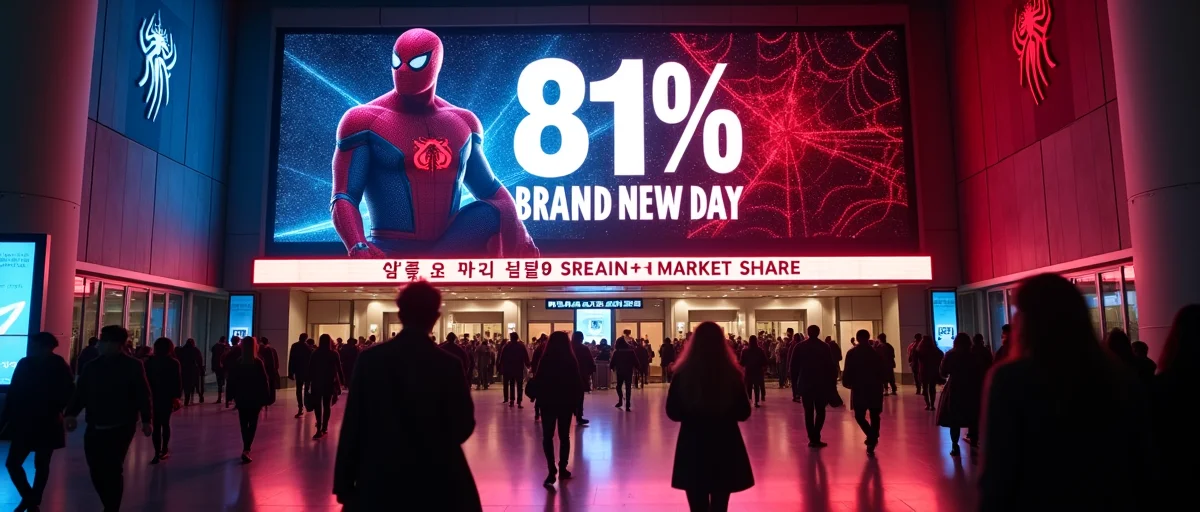
Spider-Man: Brand New Day earned $16.9M in South Korea, capturing an 81% market share. KOBIS data shows 2.25M admissions, signaling strong superhero demand.
In its first three days, ‘Spider-Man: Brand New Day’ earned $16.9 million at the South Korean box office. That figure comes from KOBIS data reported by Variety. The superhero sequel drew 2,252,930 admissions across 2,409 screens between Jul. 31-Aug. 2, 2026.
An 81% market share is extraordinary. It means the film captured four out of every five dollars spent at the Korean box office during the weekend. For comparison, a solid blockbuster debut typically takes between 40% and 60% of the market. Crossing the 80% threshold signals a rare level of audience concentration and franchise strength.
| Metric | Value |
|---|---|
| Opening weekend gross | $16.9 million |
| Market share | 81% |
| Admissions | 2,252,930 |
| Screens | 2,409 |
| Period | Jul. 31-Aug. 2, 2026 |
To put the scale in perspective, the film generated roughly $7,000 per screen over the three-day frame. This is a bullish signal for exhibitors and investors watching premium-format demand.
KOBIS compiles data from South Korea’s major theater chains and independent cinemas. It tracks real-time ticket sales and admissions, then aggregates them into daily and weekly reports. Market share is calculated by dividing a film’s total gross revenue by the nationwide total across all titles.
Like any tracking system, data coverage can vary. However, KOBIS is the most widely cited source for Korean box office performance. Its consistency allows year-over-year comparisons and cross-title benchmarking.
South Korea operates one of the world’s most transparent box office tracking systems. KOBIS, the Korean Film Council’s service, publishes daily admissions, sales, screen counts, and market share data. For financial analysts, this is a goldmine.
The ‘Spider-Man: Brand New Day’ opening is a case study in how reliable data can drive decisions.
Each of these metrics is available through KOBIS. The level of granularity helps media investors move from broad estimates to precise, data-backed assessments.
Developers can also tap into KOBIS’s open API to pull daily box office rankings and admission counts. A simple pipeline can fetch updated figures each morning, normalize the data, and feed it into a dashboard. That is exactly the kind of workflow that turns raw reporting into actionable intelligence.
For investors, box office revenue is one of the most visible components of a film’s financial lifecycle. The $16.9 million Korean debut is only the start. It feeds into international grosses, licensing, streaming windows, and merchandising.
An 81% market share also changes the competitive calculus. When one title dominates with more than 80% of the market, it compresses revenue for every other film. Local distributors and independent films will need to adjust release dates. Exhibitors, meanwhile, enjoy a high-occupancy weekend but face a sharp drop-off risk if the title stumbles in its second frame.
The data from this opening creates a useful benchmark for 2026 superhero releases. Future comparisons will reference this debut when evaluating the viability of same-weekend scheduling.
Box office share is not just a measure of ticket sales. It influences the entire financial ecosystem around a film. A strong opening weekend signals to streaming platforms, retailers, and licensees that consumer demand is high. It can accelerate merchandising deals, increase negotiating power for distribution rights, and shape the marketing strategy for global rollouts.
For a title like ‘Spider-Man: Brand New Day’, the Korean debut provides franchise owners with important commercial intelligence. A market share above 80% in a major Asian market often indicates that the brand’s local fan base is intact. That information is valuable to allocators of media budgets and to investors assessing the future value of intellectual property.
At the same time, analysts should avoid treating a single weekend as a reliable predictor. Box office performance is volatile. The second weekend holdover rate, international territories, and streaming performance all play significant roles in determining a film’s ultimate financial health.
Technology professionals can learn a great deal from this opening. The challenge is to move beyond raw numbers and build models that capture the dynamics of a concentrated market.
Here are a few practical use cases:
The ‘Spider-Man: Brand New Day’ dataset is rich enough to support all of these applications. It also illustrates why cross-referencing multiple sources, including KOBIS and trade reporting, is important.
Distributors should note the movie’s ability to convert strong fan interest into physical ticket sales. The high admission count and screen count suggest the release was well positioned across premium formats and standard screens. This kind of saturation is rare on opening weekend.
Exhibitors can use the weekend’s admissions per screen to fine-tune capacity planning. If a blockbuster captures 81% market share in a mature market, other theaters may need to allocate more screens in the first week. But they should also monitor Monday-to-Thursday drop-offs using KOBIS data to avoid over-committing in week two.
For local distributors, the lesson is more cautionary. An 81% share means little room for counterprogramming. Scheduling around major superhero openings remains essential.
The trend is clear: big-budget superhero films continue to dominate the South Korean box office. ‘Spider-Man: Brand New Day’ is the latest example of sustained audience appetite for Hollywood superhero blockbusters. The film’s opening weekend aligns with the broader upward direction of this trend into 2026.
South Korean audiences have consistently supported global superhero franchises. This weekend’s data reinforces the pattern. It also raises questions about whether the market is becoming more concentrated in fewer, bigger titles.
From a technology and analytics perspective, this concentration matters. Companies building box office forecasting models will need to weight franchise title effects more heavily. They will also need to track KOBIS data daily to catch momentum shifts.
For data engineers, the challenge is to turn raw KOBIS numbers into reliable models. The ‘Spider-Man: Brand New Day’ dataset offers enough detail to test revenue forecasting algorithms and scheduling optimization tools.
‘Spider-Man: Brand New Day’ delivered a colossal debut, capturing 81% of the South Korean box office with $16.9 million in gross revenue. The 2,252,930 admissions across 2,409 screens demonstrate that superhero blockbusters still command exceptional theatrical demand in 2026.
For professionals watching media markets, this opening weekend is not just a box office story. It is a data-rich example of market concentration, franchise strength, and the power of transparent tracking systems. The next step is to watch week two. If the holdover is strong, the film will become one of the year’s defining theatrical events.
KOBIS is the Korean Film Council's box office information service, widely regarded as one of the most transparent and reliable movie data sources in the world. It tracks real-time ticket sales, admissions, screen counts, and market share from major theater chains and independent cinemas. Analysts use KOBIS to benchmark film performances and make data-driven decisions about the South Korean market.
KOBIS calculates market share by dividing a film's total gross revenue by the nationwide total gross revenue across all films playing during the same period. For example, if a film earns $16.9 million out of roughly $20.9 million total box office revenue, its market share is about 81%. This metric measures how dominant a film is relative to competitors in the market.
An 81% market share means the film captured about four out of every five dollars spent at the box office during that weekend. Most successful blockbusters typically take 40% to 60% of the market on opening weekend, so crossing 80% signals an unusually strong audience concentration and franchise pull. It can also reflect a weak overall market with few competing titles, giving the film an outsized share.
While exact comparisons depend on the title and release timing, a $16.9 million opening with 2.25 million admissions is a very strong result for the Korean market. For context, major Marvel releases in Korea often open between $10 million and $20 million, with market shares in the 40% to 70% range. An 81% share puts this film well above typical superhero launches and suggests exceptional demand.
Admissions per screen indicates how efficiently theaters are filling seats, while market share reveals competitive dominance. For investors, these metrics help forecast a film's revenue trajectory, assess franchise strength, and evaluate the health of the theatrical exhibition sector. Strong per-screen averages and high market share often suggest a film will have good staying power and premium-format demand.