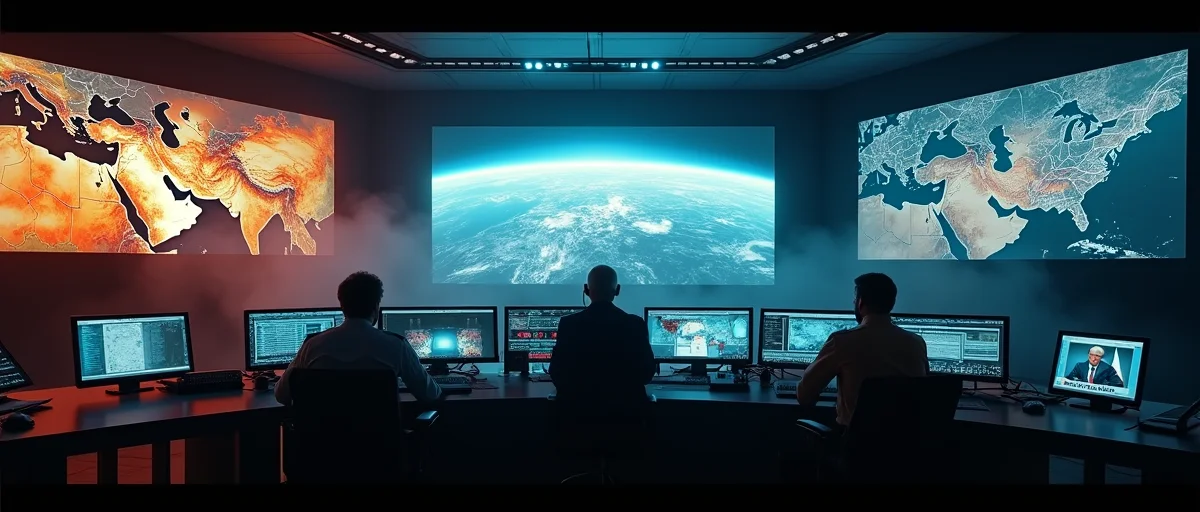
After U.S. forces intercept Iranian missiles, President Trump vows to hit Iran "hard." Rising U.S.-Iran friction brings defense, cyber, and supply-chain risks for tech.
The Middle East is bracing for potential escalation after reports on July 28, 2026 confirmed that U.S. forces intercepted an Iranian missile attack aimed at American troops. President Donald Trump responded by threatening to hit Iran “hard,” raising concerns about a broader military confrontation. For technology professionals, this is not only a foreign-policy story; it is a reminder of how geopolitical shocks can disrupt everything from defense systems to global supply chains.
According to The Washington Post, U.S. forces shot down Iranian missiles targeting American assets in the Middle East. At least one reported missile attack was directed at U.S. assets, underscoring how quickly regional tensions can ignite. The details are still emerging, but the event marks a significant moment in U.S.-Iran relations.
The response from Washington came quickly. President Trump warned that the United States would hit Iran “hard,” signaling that further military action is possible. The phrasing fits a broader pattern of direct pressure, but it also leaves many operational questions unanswered. What targets are in range? How will allies participate? And what will happen if the missile exchange continues?
One of the most important developments is Saudi Arabia’s reported participation in U.S. military strikes on Iranian proxies. The move signals a wider coalition against Iran-backed forces. It also introduces new layers of complexity for military planners and technology vendors.
Coalition operations depend on secure communications and shared situational awareness. When multiple countries are involved, data must move across different classification levels and national boundaries. This is where modern technology becomes a strategic asset. Interoperability, encryption, and real-time intelligence can mean the difference between a successful strike and a costly mistake.
For governments and contractors, this environment creates demand for:
These are not speculative products. They are immediate requirements for any conflict involving multiple regional actors.
Geopolitical conflict used to be a niche concern for defense contractors. That is no longer true. Modern technology companies depend on global infrastructure, international talent, and cross-border data flows. A conflict in the Middle East can affect undersea cables, cloud regions, and energy prices.
Security teams should also watch for cyber escalation. State-linked groups often respond to military pressure with destructive malware and phishing campaigns. Iranian cyber actors have a history of targeting critical infrastructure, including financial, energy, and transportation systems. During a hot conflict, the risk of reprisal attacks increases.
The convergence of physical and cyber domains means that military events can have immediate digital consequences. A successful denial-of-service attack, for instance, might target a government portal or a financial institution seen as supporting the U.S. response. Technology leaders should update threat models and review their organization’s exposure to region-specific risks.
The reported missile interception highlights the importance of layered air-defense systems. Modern militaries depend on sensors, radar, and data fusion to detect and destroy incoming threats. These systems rely on resilient networks that can survive electronic attack and jamming.
Technology professionals can draw useful lessons from missile defense:
The same principles apply to enterprise infrastructure. Uptime, data integrity, and rapid incident response are not just business objectives; they are national-security imperatives in a connected world.
Every company carries some amount of technical debt. Geopolitical exposure is similar. If an organization depends on a single cloud region in a volatile area, it has accumulated risk. The July 2026 U.S.-Iran episode is a useful stress test for that mindset.
Consider three common scenarios:
Each scenario is plausible. Each one can be addressed with advance planning. Multi-region deployment, vendor diversification, and robust identity management are concrete steps that reduce geopolitical risk.
The available trend data points to a rising level of direct U.S.-Iran military confrontation as of July 2026. This is not limited to proxy battles in Syria, Yemen, or Iraq. The reported missile attack targeted U.S. assets directly, and the U.S. response appears to involve regional partners.
Watching this trend is important for risk managers and technology strategists. A deeper conflict could produce sanctions, export controls, and supply-chain shocks. It could also accelerate investment in defense tech and secure communications. Startups working on space-based sensing, autonomous defense, and zero-trust networking may find new opportunities.
Geopolitical risk is often treated as an abstract concern. Here are concrete steps technology teams can take today:
These actions will not prevent geopolitical events. But they can help organizations react faster and recover more smoothly.
The evolving confrontation between the United States and Iran will likely accelerate investment in certain technologies. Satellite-based ISR, autonomous systems, directed energy, and advanced electronic warfare are all areas of active development. For technology enthusiasts, this is a space to watch.
At the same time, the commercial sector will see growing demand for cybersecurity products, secure collaboration tools, and resilient cloud services. Governments and enterprises are likely to prioritize vendors that can demonstrate reliability under pressure.
Saudi Arabia’s participation suggests that the coalition response is not limited to the United States. The coming weeks will reveal whether missile-defense intercepts prevent escalation or merely delay it. For now, the trend line is clear: U.S.-Iran friction is rising, and the region remains volatile.
Decision-makers should avoid assuming that a single military exchange will end the crisis. Instead, they should prepare for prolonged uncertainty. That means building resilient systems, diversifying suppliers, and staying informed.
The reported Iranian missile attack on U.S. assets and President Trump’s “hard” response mark a dangerous moment in the Middle East. U.S. forces successfully shot down the missiles, but the confrontation appears to be escalating. Saudi Arabia’s reported involvement adds a coalition dimension that makes the situation more fluid.
For technology professionals, the key takeaway is preparation. Secure your networks, map your dependencies, and treat geopolitical risk as a technical problem. The digital world is not separate from military conflict; it is deeply intertwined with it. By adopting a resilient mindset, organizations can reduce their exposure to events that are impossible to control but essential to withstand.
U.S. forces intercepted an Iranian missile attack aimed at American troops in the Middle East, and President Trump responded by threatening to hit Iran 'hard.' Saudi Arabia has reportedly joined U.S. strikes on Iranian proxies, signaling a wider coalition against Iran-backed forces.
An escalation could disrupt global supply chains, especially for electronics and components manufactured in the region, and increase demand for defense technologies like secure communications and AI-assisted threat detection. It also heightens cybersecurity risks, as state-backed hackers often target critical infrastructure during geopolitical crises.
Defense technology includes weapons systems, surveillance, secure communications, and software used by militaries. In a coalition operation, technologies like low-latency satellite communications, encryption, and reliable deconfliction systems are essential for coordinating strikes across different countries and avoiding costly mistakes.
Businesses may face increased phishing campaigns, ransomware, and attacks on critical infrastructure from Iran-backed groups. Companies should review their security controls, patch critical systems, and prepare incident-response plans, especially if they operate in energy, finance, or technology supply chains.
Companies can diversify suppliers, keep strategic inventory of critical components, and use real-time risk monitoring to identify disruptions early. Building relationships with alternative logistics providers and assessing exposure to Middle East transit routes are also important steps.