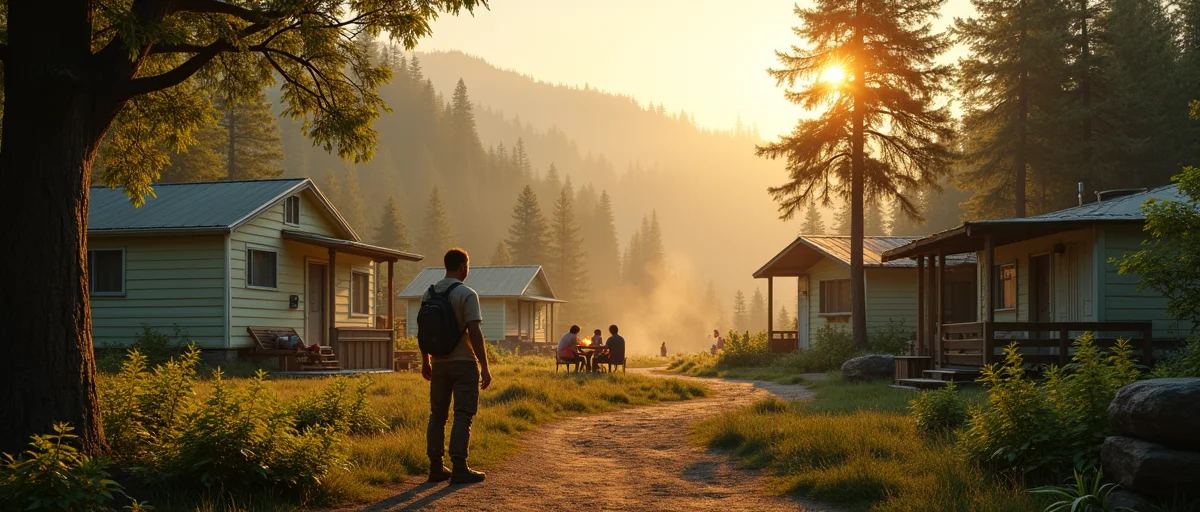
Big Walk from House House masquerades as a cozy hangout sim, but it's secretly a Predator-style multiplayer game - when voice volume doesn't ruin it.
Big Walk looks like the gaming equivalent of a spa day. It’s a 12-player cooperative open-world adventure from House House, the studio behind Untitled Goose Game, set in a sleepy post-apocalyptic world that resembles an upscale wilderness resort. The marketing sells it as a space to relax, explore, and spend quality time with friends.
But first impressions can be deceiving. Peel back Big Walk’s tranquil surface, and you’ll find something far more thrilling hiding underneath. This isn’t just a chill game to unwind with. It’s a complex multiplayer experience with a hidden competitive edge that puts players in direct tension with one another. In other words, Big Walk is secretly a predator game—and that’s exactly what makes it so fascinating.
The setup seems simple on paper. You and up to 11 other players explore a vast, beautiful landscape, solving puzzles and enjoying each other’s company. Yet beneath this relaxed exterior lies a more compelling gameplay loop, one built around stalking, observing, and outwitting the other players in your world. House House has crafted a game that wears the mask of a cozy hangout sim while delivering the pulse-quickening dynamics of a hunt.
This isn’t idle speculation from armchair analysts. The game’s most memorable moments emerge when its cooperative facade cracks, revealing a competitive core that puts players in a predator-prey relationship with each other. The original analysis from Rock Paper Shotgun captured this dynamic perfectly, describing Big Walk as “actually a serial killer training simulator”—a characterization that’s as amusing as it is accurate.
Players who’ve spent real time with the game will recognize the truth in that description. The open-world structure of Big Walk rewards players who think like hunters. It encourages careful observation, strategic positioning, and well-timed action. And it does all of this while presenting itself as a friendly, approachable adventure.
House House is no stranger to hiding depth beneath accessible surfaces. Untitled Goose Game, the studio’s breakout hit from 2019, was a stealth game disguised as a slapstick comedy about a mischievous goose. Its true appeal lay in planning, evasion, and the quiet satisfaction of outsmarting your environment. It looked cute, but playing it felt remarkably like running a heist.
Big Walk continues this tradition on a much larger canvas. On paper, it’s a cooperative multiplayer game about exploring a post-apocalyptic world. The official framing paints it as a “sleepy, post-apocalyptic Center Parcs resort,” where players can unwind and share cozy experiences with friends.
But the gameplay tells a different story. The open world is vast and unpredictable. The 12-player lobbies are large enough to create meaningful social friction. And the mechanics reward situational awareness and calculated risk-taking. These are not the hallmarks of a pure relaxation sim. They’re the building blocks of a competitive game engineered for tension.
The genius of Big Walk’s design is how it lulls players into a false sense of security. The pastel-hued world and gentle pacing lower your guard. Then, when you least expect it, the predator mechanics transform the environment into an arena of pursuit and evasion. One moment you’re admiring the view with friends; the next, you’re the prey.
The gaming industry has seen a genuine rise in “hangout games” in recent years. This trend shows no signs of slowing down. From Minecraft’s creative mode to Animal Crossing’s island life, players increasingly seek low-stakes digital spaces where they can exist with friends. Big Walk has been enthusiastically slotted into this category by players and press alike. But this framing misses what makes the game special.
The game is often described as an “antidote to friendslop.” For context, “friendslop” refers to the emergent chaos that dominates many party games and social multiplayer experiences—the shouting, the betrayal, the laugh-out-loud mishaps that come from unstructured play. An antidote to friendslop would ideally be a calm, cooperative experience where friends connect without the noise.
Big Walk, however, is not that.
Its multiplayer interactions are frequently chaotic, unpredictable, and competitive. The game’s structure encourages small groups to form, shifts alliances, and creates situations that require split-second decisions. This isn’t chaotic in the spirit of Mario Party or Fall Guys, but it’s also not the gentle, meditative co-op session its marketing suggests. It occupies a fascinating middle ground where cooperation and competition coexist—often within the same session.
This makes Big Walk a much more interesting game than a simple hangout sim. It’s a game about reading people, managing relationships, and knowing when to trust your instincts. Those skills are valuable in any multiplayer context, but Big Walk gives them unusual weight.
The predator fantasy in Big Walk emerges through several interconnected systems:
Together, these systems create a loop that feels more like a digital game of cat and mouse than a peaceful co-op adventure. The result is a multiplayer experience that challenges conventional genre boundaries and delivers something genuinely unexpected to players willing to look beneath the surface.
For all its design strengths, Big Walk has a recurring technical problem that undermines its most exciting moments: voice volume levels. The issue is inconsistent audio for player voice communication, making it difficult to hear teammates and nearby players clearly.
This might seem like a minor quality-of-life concern, but in a game built around the predator-prey dynamic, audio is everything. When you can’t reliably hear other players, the carefully constructed tension begins to unravel. A hunt fails because you don’t hear the footsteps you’re stalking. An escape fails because you can’t hear danger approaching. The moments that make Big Walk special depend on crisp, reliable audio—and inconsistent voice volume breaks that spell.
The commentary around House House “fixing the voice volume” highlights a deeper issue: patch priorities that favor comfort over intensity. Each update that smooths out the rough edges risks making the game less memorable.
There’s a genuine design tension at play. The qualities that make Big Walk’s predator moments thrilling—challenging audio cues, unpredictable interactions, high-stakes tension—are the same qualities that can make a game feel rough or punishing. House House’s instinct to polish away rough edges is understandable, but it risks dulling the very experiences that set the game apart.
The ideal path forward requires balance. Big Walk needs enough audio clarity to support its gameplay, but not so much polish that the danger becomes toothless. Players need enough unpredictability to keep things exciting, but enough structure to prevent frustration.
For now, the voice volume issue remains a notable flaw. It’s a reminder that even well-designed games can struggle with technical execution, and it’s especially impactful in a game where communication and audio play such central roles.
Big Walk’s refusal to fit neatly into a genre is more than a quirky footnote—it signals something important about the direction of multiplayer gaming. The lines between cooperative and competitive play are blurring across the industry.
Games like Dead by Daylight and Hunt: Showdown have built massive audiences around experiences where other players are simultaneously threats and partners. The social deduction boom of the early 2020s normalized the idea that your friends can also be your adversaries. Big Walk fits squarely into this tradition, even if its presentation is thoroughly unexpected.
For technology professionals and enthusiasts, the game offers a compelling case study in how mechanics, audio design, and aesthetics interact to create player experiences. It demonstrates that genre labels are increasingly insufficient descriptions of what games actually do. It also raises interesting questions about how far a game can push against player expectations before the experience fractures.
The voice volume issue serves as a practical reminder for developers: even small defects in communication systems can have outsized effects in games where interaction with other players is the core loop.
If you’re planning to jump into Big Walk, here are some practical ways to experience the hidden predator dynamics that make it special:
These approaches won’t make the voice volume problem disappear, but they’ll help you get closer to the secret predator game hiding beneath Big Walk’s cozy surface.
Big Walk is a game of delicious contradictions. It looks like a peaceful hangout sim and plays like a tense game of predator and prey. It comes from a studio known for accessible games and hides surprising competitive depth beneath its cozy aesthetic. Its only real obstacle is a voice volume issue that sometimes muffles the very elements that make it special.
The key to enjoying Big Walk is simple: arrive with the right expectations. Don’t come to it expecting a purely relaxing co-op experience. Instead, embrace the trickster energy that House House has demonstrated since Untitled Goose Game. Listen carefully. Watch the other players. And when the moment feels right, make your move.
That’s where the real magic of Big Walk lives—in the space between friend and prey, cooperation and competition. House House may continue tinkering with voice volume, but no amount of patching will remove the secret predator fantasy at the heart of the experience.
Big Walk is a 12-player cooperative open-world adventure game developed by House House, the studio behind Untitled Goose Game. It presents itself as a relaxing hangout sim, but it secretly features predator-style multiplayer dynamics that reward stalking, observation, and outwitting other players.
Beneath its cozy exterior, Big Walk encourages players to think like hunters: observe others, position strategically, and time actions carefully. The open-world structure creates a competitive tension where each player can become a predator or prey, even while the game maintains its cooperative presentation.
Both games hide deeper mechanics beneath an approachable surface, but Untitled Goose Game is primarily a stealth game disguised as slapstick comedy, usually played solo or with two players. Big Walk expands this idea into a multiplayer open world where 12 players can engage in hidden competitive predator-prey dynamics, making it a much larger and more socially complex experience.
The comparison comes from a Rock Paper Shotgun analysis that highlighted how Big Walk rewards hunter-like thinking and stalking behavior despite its relaxing presentation. The phrase is meant to be amusing but accurate: the game's most memorable mechanics are about observing, tracking, and outwitting other players, which feels similar to predator behavior.
Technically yes, but it depends on the group. The game's design intrinsically rewards competitive observation and strategic actions, so players must consciously avoid using those mechanics to keep the experience purely chill. If everyone agrees to treat it only as a hangout and ignore the predator dynamics, the open-world exploration can still be enjoyable.