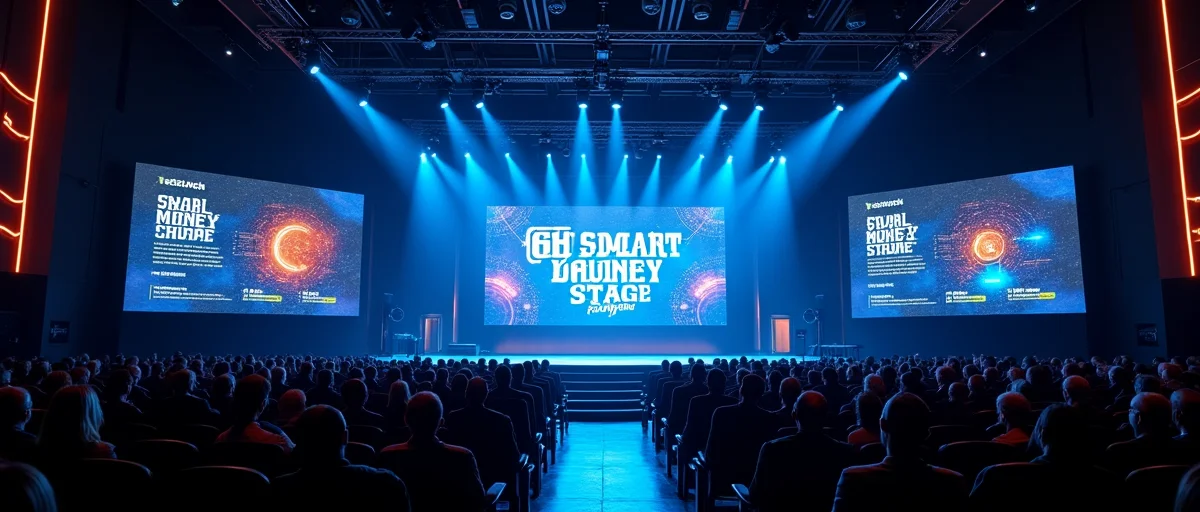
Disrupt 2026 launches the Smart Money Stage, focusing on fintech, AI, and payments. With record investment, 5 billion users, and industry leaders, this stage offers insights into the future of financial services.
Money is undergoing its most fundamental transformation in decades. It’s becoming programmable, instantaneous, and woven into the fabric of our digital lives. At the forefront of this shift is TechCrunch Disrupt 2026, which introduces the Smart Money Stage—a dedicated platform exploring the convergence of fintech, payments, and artificial intelligence. Scheduled for September 2026 in San Francisco, this new stage will host executives from Robinhood, Plaid, and other industry leaders, alongside visionary founders and seasoned investors. Together, they will dissect the forces reshaping financial services: from open banking infrastructure to AI-powered fraud detection. The Smart Money Stage is not just an event track; it’s a critical conversation about the future of value exchange in the digital age.
TechCrunch Disrupt has long been a hallmark event for technology entrepreneurship, but the Smart Money Stage marks a thematic expansion into one of the most dynamic sectors: financial services. This dedicated track underscores the growing recognition that fintech, payments, and AI are converging to create new business models and consumer experiences. “The Smart Money Stage will bring together the most innovative minds in fintech and AI to discuss the future of financial services,” a TechCrunch spokesperson said. The stage is designed to facilitate deep dives into infrastructure, regulation, and innovation—all essential for anyone building in fintech or adjacent spaces.
Confirmed participants include consumer investment platform Robinhood and data connectivity giant Plaid. Their presence highlights the two sides of fintech: direct consumer value and the underlying technological plumbing. The Smart Money Stage will also feature breakout sessions, fireside chats, and panel discussions covering everything from decentralized finance to digital identity. By focusing on both the front-end and back-end of financial services, the stage promises a holistic view of an industry in flux.
The numbers behind fintech’s rise are staggering. According to KPMG’s Pulse of Fintech, global fintech investment reached $210 billion in 2025. This influx of capital is fueling a wave of innovation across payments, lending, insurance, and wealth management. But it’s not just about money flowing to startups; it’s also about user adoption. Statista projects that the number of digital payment users will surpass 5 billion by 2026. That represents nearly two-thirds of the global population transacting digitally—a shift with profound implications for financial inclusion and commerce.
Artificial intelligence is a key accelerator. Grand View Research pegs the AI in fintech market at $22.6 billion in 2025, with a compound annual growth rate (CAGR) of 28.5% through 2030. Financial institutions are deploying AI for everything from fraud detection and risk management to personalized recommendations and customer service. These statistics paint a clear picture: fintech is not just growing; it’s being supercharged by AI and massive user adoption.
One of the most immediate applications of AI in financial services is fraud detection. The implementation of AI in fraud detection has seen a 30% increase across payment systems in 2025-2026. Machine learning models can analyze millions of transactions per second, identifying anomalies with far greater accuracy than traditional rule-based systems. This not only reduces losses but also improves the user experience by minimizing false declines.
Beyond fraud, AI is transforming how financial products are delivered. Robo-advisors manage portfolios, chatbots handle customer inquiries, and algorithms assess creditworthiness using non-traditional data. “Companies like Plaid are building the plumbing for a new financial system, and this stage will explore that infrastructure,” noted a panelist at Disrupt 2026. Plaid’s APIs connect thousands of apps to bank accounts, enabling real-time access to financial data—a cornerstone for many AI-driven services. The Smart Money Stage will feature experts who build and deploy these technologies, offering attendees actionable insights.
Two trends are reshaping the payments landscape: real-time payments and embedded finance. Real-time payment systems, like FedNow in the U.S. and UPI in India, are seeing explosive growth. According to FIS, real-time payments experienced 35% year-over-year adoption growth in 2025. Consumers and businesses increasingly expect instant settlement, whether for peer-to-peer transfers or commerce. This shift requires robust infrastructure and intelligent risk management—areas where AI plays a crucial role.
Embedded finance is equally transformative. Accenture reports that 45% of companies plan to adopt embedded finance solutions by 2027. This includes integrating lending, payments, or insurance directly into non-financial platforms. For example, a rideshare app might offer instant driver payouts, an e-commerce site might provide buy-now-pay-later at checkout, and a travel booking platform might bundle trip insurance. These services rely on APIs, real-time data, and AI underwriting. The Smart Money Stage will dedicate sessions to the implementation of embedded finance, covering technology stack decisions, regulatory considerations, and partnership models.
These examples illustrate how finance is becoming an invisible layer, integrated into the user journey. The Smart Money Stage will showcase the companies and technologies making this possible.
The stage will feature companies that are defining the new financial stack. Robinhood revolutionized retail investing with a commission-free model and a user-friendly app. Its journey highlights the power of consumer-first design and the challenges of scaling a regulated platform. On the infrastructure side, Plaid has become the backbone of financial data connectivity, enabling apps like Venmo, Betterment, and Acorns to access account information securely.
“We’re entering an era where money is not just stored but also programmed and integrated into every aspect of our lives,” said Connie Loizos of TechCrunch. This quote encapsulates the vision behind the Smart Money Stage: money as a programmable asset rather than a static store of value. The stage will explore how developers can build financial products using APIs, smart contracts, and artificial intelligence.
These topics are critical for any professional involved in technology or finance. The Smart Money Stage provides a unique opportunity to learn from pioneers and peers.
As we look ahead, money is evolving into a dynamic digital asset. Programmable money can automate payments based on conditions, support microtransactions, and enable new forms of value exchange. AI will personalize financial services at scale, offering tailored advice and products. The Smart Money Stage will be a launchpad for these ideas, fostering collaboration that could define the next decade.
TechCrunch Disrupt 2026’s Smart Money Stage is a must-attend for anyone looking to understand where fintech, AI, and payments are headed. With comprehensive coverage of technology, business models, and regulatory landscapes, the stage offers a 360-degree view of the financial revolution. Mark your calendar for September 2026 in San Francisco and join the conversation that is rewriting the rules of money.
The convergence of fintech, AI, and payments is creating unprecedented opportunities and challenges. The Smart Money Stage at TechCrunch Disrupt 2026 is where the brightest minds will gather to navigate this transformation. Armed with record investment data, insights from industry leaders, and a focus on actionable trends like embedded finance and real-time payments, attendees will leave with a clear roadmap for the future. Don’t miss your chance to be part of the revolution.