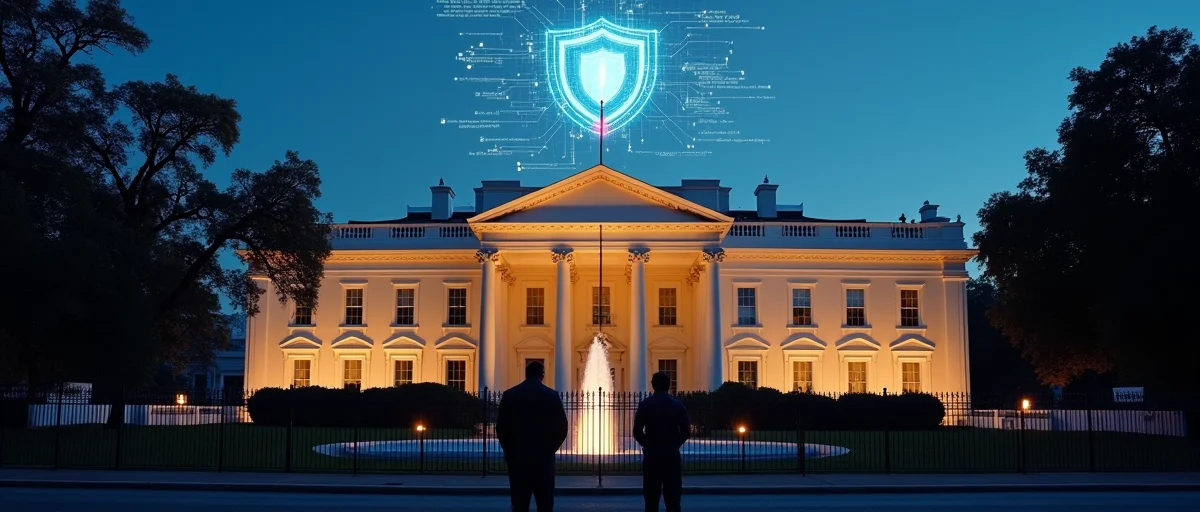
President Trump has signaled a potential shift in U.S. AI policy, saying he is considering new controls in response to reported hacking incidents at OpenAI. The move could mark a departure from the administration's hands-off approach, with national security concerns driving the conversation.
President Trump has indicated he is considering new artificial intelligence controls in the wake of reported hacking incidents involving OpenAI, signaling a potential shift from his administration’s earlier hands-off approach to the technology. The proposed measures are still under consideration, with no specific policy or regulatory actions announced yet. For technology professionals and AI stakeholders, this development could reshape the regulatory landscape for years to come.
For much of the Trump administration, AI policy has favored a light-touch approach, prioritizing rapid innovation and American competitiveness in the global AI race. However, recent cybersecurity events appear to be changing that calculus.
According to BBC News, “It marks a change of tone for his administration, which has taken a more hands-off approach to the technology.” That shift, while still in its early stages, reflects a broader recognition that AI systems—and the infrastructure that supports them—are becoming critical national security assets.
The key question now is not whether the administration will act, but how quickly and in what form. Technology companies that have benefited from minimal AI regulation may need to prepare for a more scrutinized operating environment.
The reported hacking incidents at OpenAI have become a catalyst for renewed national security discussions around artificial intelligence. While specific details of the incidents have not been fully disclosed, the events have raised alarms about vulnerabilities in AI infrastructure, including model repositories, internal research, and user data.
These incidents underscore a broader risk: advanced AI models possess capabilities that are highly valuable to foreign adversaries. State-backed hackers and criminal organizations increasingly view AI companies as prime targets, seeking to steal proprietary research, compromise model integrity, or access sensitive user information.
AI systems face a unique set of cybersecurity challenges:
These threats are not hypothetical. They represent real, evolving vectors that security teams at AI companies must defend against daily. The OpenAI incidents serve as a reminder that even the most advanced AI organizations are not immune to determined adversaries.
National security concerns around foreign access to advanced AI systems appear to be a central motivator behind the president’s comments. AI technologies now underpin defense systems, intelligence analysis, critical infrastructure management, and economic planning—making them consequential beyond the private sector.
If a foreign adversary were to gain unauthorized access to leading AI models, the potential consequences include:
These risks explain why the administration is contemplating stronger controls despite its traditional pro-innovation stance. The tension between market freedom and national security is now front and center in AI policy discussions.
The development signals possible tension between the administration’s pro-innovation stance and growing cybersecurity threats to AI infrastructure. This tension is not new, but it has become more acute as AI capabilities have advanced rapidly.
On one hand, the U.S. wants to maintain leadership in AI, competing with China and other nations in a technology race that has geopolitical implications. Overly restrictive controls could slow domestic innovation and cede ground to international competitors.
On the other hand, the security risks associated with open, unregulated AI development are becoming harder to ignore. A policy response that satisfies both imperatives will require careful calibration.
The situation bears similarities to earlier debates over critical infrastructure protection, encryption policy, and export controls on sensitive technologies. In each case, the government has had to balance enabling legitimate innovation while preventing dangerous misuse.
For AI, that balance is complicated by the technology’s dual-use nature. The same models that power helpful applications like chatbots, medical diagnosis, and code generation can also assist in cyberattacks, disinformation campaigns, and autonomous weapons development.
This duality makes blanket regulations difficult to design effectively. Technology professionals should anticipate a nuanced policy response that targets specific risk areas rather than broad industry-wide restrictions.
While no specific measures have been announced, the administration’s consideration of AI controls could lead to several possible policy directions:
These measures would represent a meaningful departure from the current regulatory environment, where AI companies largely self-regulate and voluntary commitments are the norm.
For technology professionals, the possibility of new AI controls carries significant implications across multiple domains.
Expect heightened scrutiny of your security practices. Companies developing frontier AI models may need to demonstrate robust protections for training infrastructure, model weights, and deployment pipelines. This could mean larger security budgets, more rigorous audits, and closer collaboration with federal agencies.
Organizations that purchase AI services or integrate AI into their operations should monitor for changes in vendor obligations and compliance requirements. New regulations could cascade from leading AI providers to their enterprise customers, affecting procurement, data handling, and risk management strategies.
AI-specific cybersecurity skills will become increasingly valuable. Professionals who understand how to protect machine learning systems, detect adversarial attacks, and respond to AI-focused breaches will be in high demand as both regulators and companies prioritize AI security.
Industry observers point to two converging trends heading into 2025: rising US federal AI regulation and increasing AI-related national security scrutiny. These trends are likely to accelerate in response to both the OpenAI incidents and broader geopolitical pressures.
Without specific numeric data disclosed in the BBC report, the precise impact remains difficult to quantify. However, the directional shift is clear—AI regulation is moving from the periphery to the center of federal policy conversations.
Organizations that take proactive steps now to strengthen their AI security posture, document compliance efforts, and engage with policymakers will be better positioned for whatever regulatory framework emerges. Those that assume the hands-off era will continue indefinitely may find themselves reactionary and exposed.
The Trump administration’s consideration of AI controls in response to the OpenAI hacking incidents represents a potential inflection point in U.S. technology policy. The move reflects a broader recognition that AI systems have become too consequential for unchecked, unprotected growth.
Key takeaways for technology professionals:
The tension between promoting innovation and securing AI infrastructure will not be resolved quickly. But the direction of travel is increasingly clear: AI oversight is coming, and the organizations that adapt early will lead in the next phase of the AI era.
The reported hacking incidents at OpenAI raised alarms about vulnerabilities in AI infrastructure, including model theft and access to proprietary research. These national security concerns have led the administration to reconsider its earlier hands-off approach to AI regulation.
No specific policies or regulatory actions have been announced yet. Potential measures could include stricter security standards for AI companies, increased oversight of sensitive AI research, or new requirements for protecting user data and model integrity.
AI companies could face a more scrutinized operating environment with potential compliance costs and security mandates. They may need to invest more heavily in cybersecurity, limit certain types of research sharing, and prepare for greater government oversight.
Key threats include model theft, where attackers extract proprietary AI models; compromise of model integrity through tampering; and breaches of internal research or user data. State-backed hackers and criminal groups increasingly view AI companies as high-value targets.
It's still early, and the shift is in its initial stages. The administration's actions will depend on how the situation develops, but the recognition of AI as critical national security infrastructure could lead to lasting regulatory changes.