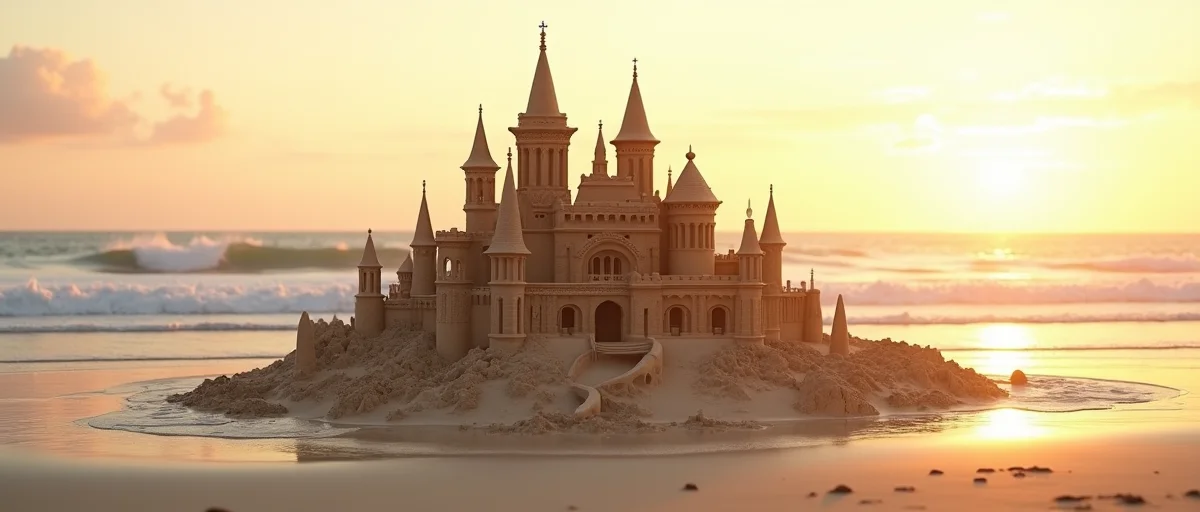
Dive into Sandcastle, the hyper-realistic physics simulation game that lets you build intricate sandcastles without the ocean spray. Discover how this niche title is captivating tech professionals with its accurate physics engine and offering a unique vicarious beach experience.
In an era where video games push the boundaries of sprawling open worlds and hyper-competitive multiplayer arenas, a quiet revolution is taking place. It is found in the granular details, the precise calculations, and the serene act of creation. Welcome to Sandcastle, a physics-accurate sandbox simulation game that strips gaming back to its purest, most satisfying elements: building something from nothing. For technology professionals and enthusiasts who appreciate the intricate dance between code and consequence, Sandcastle offers more than just a game—it provides a meticulously crafted digital laboratory. It delivers a vicarious beach experience for players who may not live near the coast, focusing entirely on the art and science of constructing the perfect structure using realistic materials.
The gaming industry has experienced an extraordinary explosion in hyper-specific simulation titles. From farming to power washing to fixing broken PCs, players are increasingly flocking to experiences that focus on a single, meditative task. Sandcastle fits perfectly into this trend, catering explicitly to beach lovers and simulation enthusiasts who prioritize realistic physics and creative freedom over traditional gameplay loops.
This niche appeal does not imply small ambition. The developers have tapped into a fundamental human desire to create and the modern technologist’s deep appreciation for well-crafted systems. Just as “PowerWash Simulator” found an audience in the ASMR-like satisfaction of cleaning, Sandcastle finds its core audience in the structural integrity of digital sand and the joy of watching a simulation run its course correctly.
To understand Sandcastle is to understand its physics engine. The game does not rely on simple voxels or pre-set building blocks commonly found in other sandbox titles. Instead, it employs a granular particle physics system that treats every grain of sand as an individual entity with properties like mass, friction, and cohesion.
A fundamental aspect of real-world sandcastle engineering is the moisture content. Dry sand collapses easily. Wet sand, held together by the surface tension of water, can form impressive, gravity-defying structures. Sandcastle meticulously simulates this dependency:
For the technology enthusiast watching a stream or playing, the beauty lies in the simulation’s immediate feedback loop. Every collapsed wall is a lesson in shear stress, every stable arch a triumph of applied mechanics. It stands as a impressive testament to how far physics processing and GPGPU computing have come in modern gaming hardware.
The game targets two distinct, yet overlapping, groups: beach lovers and simulation enthusiasts. For the tech professional, it serves a uniquely compelling purpose that goes beyond simple entertainment.
For programmers, engineers, and data scientists, Sandcastle functions as more than a relaxation tool. It serves as a “toy problem” made visually manifest. It allows the user to intuitively explore complex concepts such as:
As one community sentiment echoed on simulation gaming boards: “It’s fascinating to see a physics engine applied with such singular focus. It allows for a level of control and experimentation that broader games simply cannot offer.” Many developers find themselves drawn to such simulations not just for play, but for genuine technical inspiration.
Conversely, for the user stuck in a landlocked office or an urban jungle, Sandcastle offers a deeply sensory recreation of the beach experience. The sound of rolling waves, the visual warmth of a sunset over the water, and the tactile texture of the sand provide a powerful, meditative escape. It successfully targets the emotional need for a vacation without the travel costs.
While primarily a game, Sandcastle possesses surprising utility for creative and professional applications.
By providing a sandbox that fundamentally respects the laws of physics, the developers have created a tool that is as much about learning and discovery as it is about playing.
The emergence and success of a game like Sandcastle signals a significant shift in the broader gaming landscape. It proves there is a hungry audience for software that respects the intelligence of the player and the fidelity of its simulation.
We can expect more independent developers to follow this path, creating deeply focused simulations that offer unparalleled realism in a specific niche. The “joy of simulation” is a powerful driver in the modern tech ecosystem, and Sandcastle is at the forefront of this wave.
Sandcastle is a brilliant example of how focusing intensely on a single, well-executed idea can result in an unexpectedly profound experience. It successfully marries the unbridled creativity of a sandbox with the rigorous constraints of a physics simulation, creating a unique product that is both deeply relaxing and intellectually stimulating.
For the technology professional, it offers a beautiful case study in efficient code, realistic physics modeling, and user-centric design philosophy. For the casual player, it offers a perfect, bite-sized piece of the beach, regardless of their physical location.
Key Takeaways:
Whether you are looking for a way to unwind after a long day of debugging, or a digital sandbox to test structural theories, Sandcastle invites you to grab a virtual bucket and spade. The beach is waiting, and the physics are astoundingly delightful.
Sandcastle is a physics-accurate sandbox simulation game that focuses exclusively on building sandcastles using realistic granular material physics. It simulates individual sand particles with properties like grain size, moisture content, and angle of repose, allowing players to construct intricate structures without the usual beach environment.
The game emphasizes understanding sand's natural angle of repose, which determines slope stability. Players must manage moisture levels to increase cohesion, compact layers for strength, and carve out shapes carefully to avoid triggering collapses. Mastering the physics of wet versus dry sand is essential for successful construction.
Sandbox mode gives unlimited sand and no constraints for creative free build, while Survival mode introduces a dynamic tide that periodically erodes your castle, requiring you to plan for structural integrity and quick repairs. Survival adds a time-pressure element and challenges players to maintain their creations against natural forces.
Sandcastle requires at least a modern quad-core processor, 16GB of RAM, and a dedicated GPU with 4GB+ VRAM (e.g., NVIDIA GTX 1660 or AMD RX 580) because of the complex particle physics calculations. For the highest settings and large builds, recommended specs include an 8-core CPU, 32GB RAM, and an RTX 3070 or better.
The developers have confirmed plans for a VR mode to enhance immersion, as well as cooperative multiplayer allowing friends to build together and share creations. These features are currently in early development, with the core PC release first before expanding into these experimental realms.