NVIDIA reveals why behavioral cloning isn't enough for robust AI. Hybrid learning with demonstrations, reinforcement, and simulation is the answer.
For years, the AI industry believed imitation was the fastest path to intelligent machines. Teach a robot to mimic human actions, and it will eventually master the task. But NVIDIA’s latest research reveals a fundamental flaw in that assumption: behavioral cloning—copying human actions—is insufficient for robust AI, especially when facing novel or complex environments. The company is pioneering a hybrid approach that pairs human demonstrations with reinforcement learning, enabling AI to understand the consequences of its actions, not just copy their appearance. This shift is reshaping what we mean by machine learning.
Behavioral cloning treats AI training like a video recording. The system watches human actions, maps inputs to outputs, and replicates the behavior. It sounds straightforward, but it breaks down in the real world.
The core problem? Novel environments. When a robot trained through pure behavioral cloning encounters a situation it has never seen, it has no mental model to guide its decisions. It is mimicking patterns rather than understanding causes.
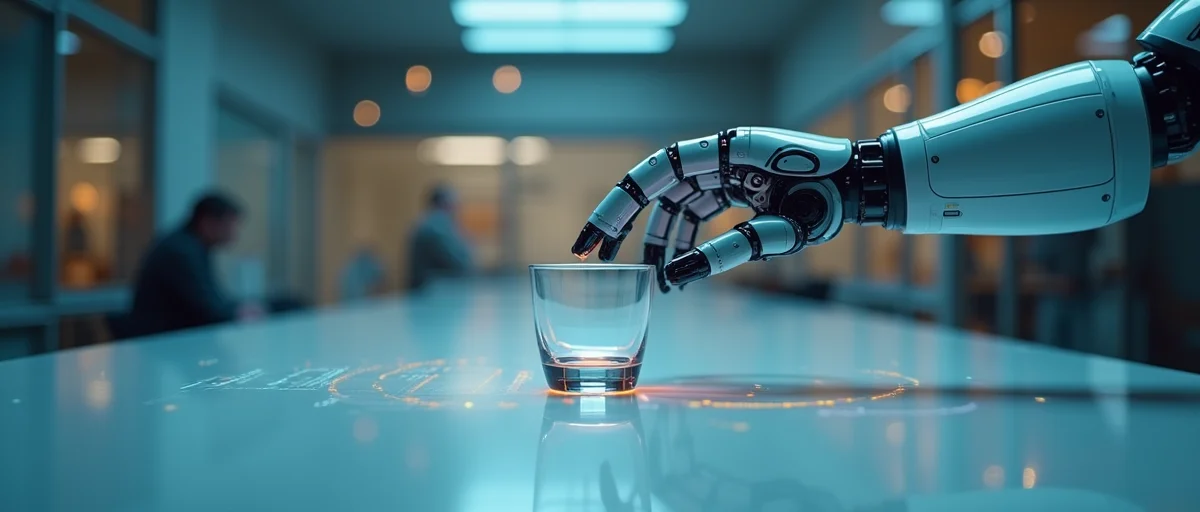
Consider a robot trained to pick up a cup. It learns the motion, the grip, and the lift. Now imagine that same cup is partially hidden behind a stack of books. The robot struggles because it lacks the causal understanding to plan around obstacles. It knows the motion, not the intent.
NVIDIA’s research identifies this as the central weakness of behavior-matching approaches. They produce experts in controlled settings but brittle performers in the wild. The result: systems that excel in tests but stumble in real-world scenarios.
The root cause is structural. Behavioral cloning establishes a direct mapping from observation to action. There is no internal model of physics, no understanding of goals, no mechanism for evaluating consequences. The AI learns the form of a behavior without its function.
NVIDIA’s solution reframes the learning problem. Instead of asking “what did the human do?” the AI learns “why did that action work?” That requires more than imitation—it requires experience.
Reinforcement learning provides that experience. The AI takes actions, observes outcomes, and adjusts based on rewards. NVIDIA’s key insight is combining reinforcement learning with human demonstrations. The demonstrations give the AI a strong starting point. The reinforcement learning then refines and expands that starting point through exploration.
The AI doesn’t just learn that a particular gripper position precedes a successful lift. It learns that the gripper position matters because it affects stability, friction, and control. It internalizes the consequences of each micro-action.
This is a fundamental difference in learning objectives. Behavioral cloning tries to match an expert’s output. NVIDIA’s hybrid approach tries to match an expert’s outcome, while understanding the underlying mechanics.
The result is AI that transfers knowledge between contexts. Because the AI understands task intent, it can adapt its behavior to new conditions. That adaptability is the essence of generalization.
To develop this deeper understanding, NVIDIA uses simulation as a training ground. In a simulated environment, the AI explores interactions freely, making mistakes and observing the results at scale.
Physical causality becomes clear through experience. The AI learns that excessive force displaces objects. It learns that certain approaches produce more stable grasps. These lessons emerge not from human demonstration but from millions of simulated interactions.
Simulation provides several distinct advantages:
The combination is potent. Humans guide the AI toward promising strategies; simulation lets the AI deepen those strategies through experience. In the process, the AI gains a far richer understanding of physical causality and task intent than either method alone could provide.
The implications extend far beyond robot arms in research labs. Every domain that relies on AI to act in physical or dynamic environments stands to benefit.
Autonomous vehicles: Self-driving cars face endless novel situations—unusual road layouts, unpredictable pedestrians, erratic drivers. An AI built on behavioral cloning alone cannot handle these edge cases gracefully. NVIDIA’s approach promises vehicles that understand the intent and physics of driving, not merely recorded steering angles.
Industrial robotics: Manufacturing environments are controlled but never static. Parts arrive in different orientations, quantities fluctuate, subtle variations occur. Robots that understand task intent can adapt on the fly, without costly reprogramming.
Healthcare and assistive devices: Robots that assist in surgeries or patient care operate in high-stakes, variable environments. The capacity to understand the purpose of an action—not just its form—is critical for safe adaptation.
Simulation-to-real transfer: This research aligns with a broader industry trend. Systems that train in rich simulated worlds transfer their knowledge to physical reality more reliably when training includes causal learning, not just imitation.
The theme connecting these applications is adaptability. Real-world environments are never fully predictable. AI that imitates can only perform what it has seen. AI that understands can navigate what it has never seen.
NVIDIA’s research builds a compelling case: the future of AI lies in a hybrid paradigm, where humans provide initial guidance and AI self-improves through experience.
In this model, humans do not need to program every behavior or demonstrate every scenario. They provide demonstrations that convey key skills and intentions. Then the AI takes over, exploring and refining through experience.
This produces an AI that is both more capable and more efficient to train.
The human role shifts from producing exhaustive training data to providing direction. Instead of showing a robot every possible path, humans show it a few good paths. The AI then discovers its own paths, potentially surpassing human performance in the process.
This is how human expertise becomes a seed rather than a ceiling.
The implications for the broader AI industry are significant. Data collection for behavioral cloning is expensive, especially in domains requiring expert demonstrations. Hybrid approaches reduce that burden. AI systems can learn from smaller, less exhaustive datasets—provided they are paired with a strong experiential learning signal.
Despite the promise, the hybrid paradigm faces meaningful challenges.
Simulation fidelity is one. If the AI learns physical causality in simulation, the simulation must be accurate enough. Poor simulations teach wrong lessons, and the AI will struggle to transfer its knowledge to the real world.
Reward design is another. Reinforcement learning relies on well-crafted reward signals. For complex tasks, defining what counts as “success” can be as difficult as performing the task itself. NVIDIA’s research navigates this by deriving rewards from physical outcomes in simulation.
Scalability also matters. Reinforcement learning is computationally intensive. Simulation makes it feasible, but training large-scale models through millions of interactions still demands substantial infrastructure.
These challenges are significant, but they are engineering problems, not fundamental roadblocks.
NVIDIA’s research positions hybrid learning as essential for generalizable AI. Human guidance provides the starting point, but the AI must go beyond copying to achieve robust understanding.
The path forward points toward increasingly sophisticated training ecosystems:
The ultimate goal is AI that performs well not in the environment where it was trained, but in the unpredictable world where it will be deployed. And the route to that goal runs through understanding, not imitation.
NVIDIA’s research delivers a clear message: copying humans is not enough for AI to become truly capable. Robust AI requires more than behavioral cloning. It needs to understand consequences, build a working model of physical causality, and grasp task intent.
The hybrid approach—human demonstrations paired with reinforcement learning in simulation—offers a practical path to that understanding. It combines the efficiency of human guidance with the depth of experiential learning.
For AI practitioners, the takeaway is straightforward. Don’t settle for imitation. Build systems that can explore, experiment, and understand the why—not just the how. Because the AI that understands its actions will always outpace the AI that merely imitates them.
Behavioral cloning is a machine learning approach where an AI system learns to mimic human actions by mapping observed inputs to outputs. It treats training like a video recording: the system watches human demonstrations and replicates the behavior. However, it often fails in novel situations because it copies the form of an action without understanding the underlying cause or consequences.
Behavioral cloning fails because it lacks a causal model of the world. A robot trained this way can reproduce actions it has seen, but it cannot adapt when circumstances change, such as an object being partially hidden or a new obstacle appearing. Since it never learns why an action worked, it becomes brittle outside the exact conditions of its training data.
NVIDIA combines human demonstrations with reinforcement learning so the AI learns not just what action was taken, but why that action produced a good outcome. Demonstrations provide a strong starting point, while reinforcement learning lets the AI explore, experience consequences, and refine its behavior through rewards. This hybrid method helps the AI generalize better to new and complex situations.
Behavioral cloning is imitation-based: the AI learns to copy human demonstrations directly. Reinforcement learning is experience-based: the AI takes actions, observes the results, and adjusts its behavior to maximize rewards. The key difference is that reinforcement learning builds an understanding of consequences, while behavioral cloning only learns to match observed patterns.
The practical benefits include more robust AI systems that can handle novel environments, better generalization to complex tasks, and reduced need for massive labeled demonstration datasets. By combining demonstrations with reinforcement learning and simulation, developers can train AI to understand intent and outcomes, not just replicate motions. This makes AI more reliable when deployed in the real world.