An exploration of the Cooper Hewitt's 'Art of Noise' exhibition, revealing how jukeboxes and phonographs turned music listening into a shared, social 'team sport.' This stands in stark contrast to the isolated habits of modern streaming, and the article examines the design, culture, and quiet resurgence of communal listening.
Imagine a room full of people, their conversations a vibrant hum. Suddenly, the atmosphere shifts as someone approaches a glowing, wood-paneled monolith. A coin drops. Buttons light up. A mechanical arm whirs, lifting a heavy vinyl disc. A crackle fills the air, followed by music. Heads nod. Conversations pause. For three minutes, a room full of strangers shares a single, deliberate auditory moment. This was the ritual of the jukebox—a technology that transformed listening from a solitary, passive activity into a public, communal event.
Now, picture the present. The soundtrack of our lives is largely personal. We curate private playlists for our commutes, block out the world with noise-canceling headphones, and let algorithms decide our sonic mood. While streaming offers incredible convenience and choice, something fundamental has been lost: the social contract of shared listening. The exhibition “Art of Noise” at the Cooper Hewitt Smithsonian Design Museum in New York serves as a powerful time capsule, reminding us of a time when listening to music was a team sport.
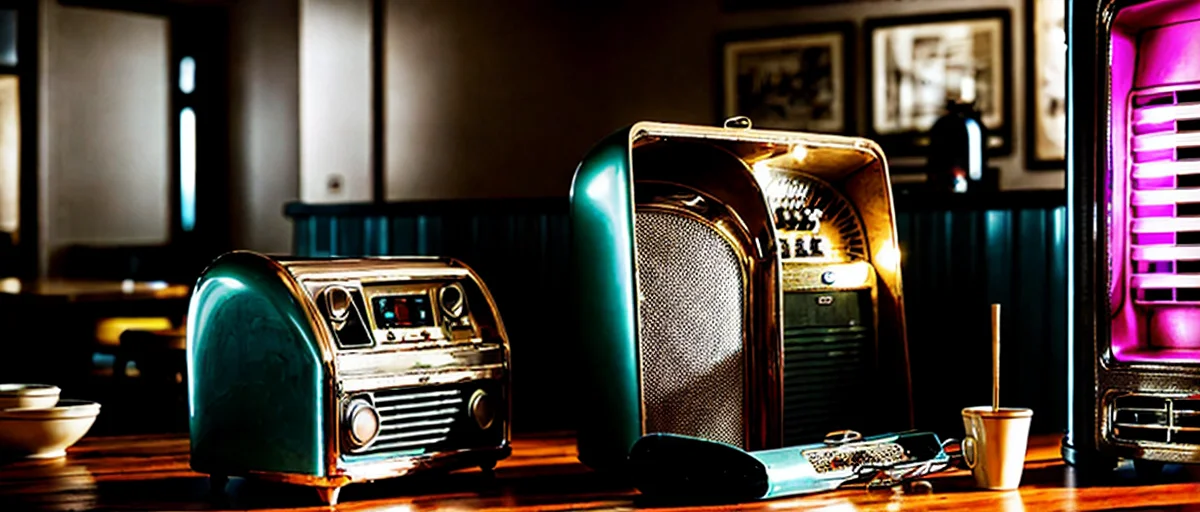
The “Art of Noise” is more than a nostalgic look at vintage audio equipment. It is a carefully crafted narrative about how the design of technology dictates our social behavior. The exhibition curates a history of music machines—from hand-cranked phonographs to mid-century hi-fi consoles and neon-lit jukeboxes—framing them not just as audio devices, but as masterpieces of industrial design that actively shaped human interaction.
Curators of the exhibition argue that these devices were the original “social hardware.” Their materiality was intentional. A jukebox demanded to be the center of the room. The iconic 1946 Wurlitzer 1015, for instance, used glowing bubble tubes and illuminated plastic to draw a crowd. Unlike a smartphone, designed to disappear into a pocket and isolate the user, these machines were designed as anchors of social gravity. They required a communal investment of attention.
The jukebox is the purest expression of this communal philosophy. It functioned as a public playlist, turning every listener into a temporary DJ. Approaching a Wurlitzer or a Rock-Ola was an act of social negotiation.
This stands in stark contrast to the digital playlist, where choice is private, infinite, and risk-free. The finite collection of the jukebox—limited to the 45s inside—also made every selection feel significant.
Before the personal stereo, the family hi-fi console was the heart of the home. These were not merely speakers; they were sculptural furniture pieces, status symbols, and gathering points. Listening to a new album was a scheduled, collective activity. The family would gather, pulling the record from the sleeve, carefully placing the needle, and experiencing the album as a linear, uninterrupted journey.
The ritual of the album flip forced a natural pause—a moment to discuss the first half before diving back into the music. The design of the console implicitly told its users: This is an important moment. It required attention, contrasting sharply with the “background listening” habits of modern streaming.
The shift from the team sport to the solo race began with the Sony Walkman in 1979. For the first time, high-fidelity music was completely portable and private. Social critics correctly predicted it would atomize the shared listening experience.
The cultural shift was seismic. The Walkman didn’t just change where we listened to music; it changed how we related to it. Music became a tool for managing your personal environment, a shield against the outside world.
The digital revolution accelerated this trend. The iPod and subsequent streaming services put infinite music in our pockets but removed the social context. The algorithm, designed to understand our solitary habits perfectly, built a wall around our taste. While the data shows streaming’s dominance is stable, the trade-off is profound. We gained a universe of music but lost the shared moment.
The desire for connection, however, is proving resilient. A powerful counter-movement is challenging the isolation of streaming. The data shows a 15% rise in vinyl sales over the last five years, but the trend is deeper than format fetishism. It is a search for the social experience.
This resurgence proves that the “team sport” of music listening is an innate human need that the frictionless convenience of streaming failed to satisfy.
For technology professionals, the “Art of Noise” exhibition offers critical lessons in UX design and product strategy.
The ritual of the jukebox was filled with friction: finding a coin, walking to the machine, making a public choice. UX design often treats friction as a bug, but here it created ceremony and engagement. This aligns with the concept of “Slow Technology,” which argues for designs that support reflection and social connection rather than optimizing purely for speed.
The physical design of a device dictates how people interact around it. A smartphone is designed for one pair of eyes and ears. A jukebox is designed for a crowd. As we move into spatial and ambient computing, technologists must consider how their hardware shapes social behavior. Are you building a device that connects people or isolates them?
The algorithm is efficient, but it lacks social context. The “Art of Noise” champions the value of shared human curation. The future of music technology may not be about perfecting the algorithm, but about building tools that make human curation more social, meaningful, and accessible.
The “Art of Noise” exhibition is a poignant critique of our present and a roadmap for the future. It argues that the history of music technology is fundamentally a history of social connection. As streaming solidifies its dominance, the resurgence of vinyl bars, listening parties, and digital Jam sessions proves that the human desire for shared experience is too strong to be silenced by convenience alone.
For the technology professional, the lesson is clear. The most successful products of the future will not just deliver content to an individual. They will create the architecture for a collective moment. The best playlist isn’t the one the algorithm writes for you. It’s the one your friend plays on the jukebox.
The 'Art of Noise' is an exhibition at the Cooper Hewitt Smithsonian Design Museum in New York that explores the history of music machines like jukeboxes and phonographs. It highlights how these devices were designed as 'social hardware' to encourage communal listening, contrasting with today's isolated streaming habits.
Jukeboxes served as the centerpiece of social spaces, drawing people together with captivating designs like glowing bubble tubes and illuminated panels. By requiring a coin drop and collective selection, they turned music playback into a shared event where strangers could experience a deliberate auditory moment together.
Listening bars are intimate venues that prioritize high-quality sound and a social, focused listening experience, often playing vinyl records. They represent a quiet resurgence of communal listening, recreating the shared atmosphere and deliberate engagement that defined the jukebox era.
Streaming services prioritize personal playlists and convenience, often isolating listeners with headphones and algorithm-driven recommendations. In contrast, jukeboxes required public interaction and collective attention, making music a social event rather than a private soundtrack.
The exhibition demonstrates that the design of technology directly shapes how we interact with music and with each other. It suggests that designing for community—as seen in the iconic Wurlitzer jukebox—can foster connection, offering lessons for creating more meaningful social experiences today.